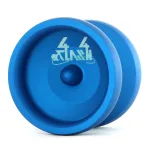
“After some revamps and classic releases, we decided it was time for something new. However, we didn’t just want to drop a new “normal” yoyo, we went for something special and weird.
Out came the Blackbelt – a super slimline fullsize diameter bi-metal saucer.
Its large diameter paired with the thick belt offers nice beefy spintimes. The sub 30mm width gives it a unique feel and awesome pocket friendliness (you can leave your holsters at home).
Even though Blackbelt is only 28mm wide, we were able to add a proper IRG for easy thumbgrinds. Alongside with our classic ILYY hub the Blackbelt is THE perfect addition to our line-up and every collection.
The Blackbelt features the awesome 7068 aluminum alloy and the same ceramic-touch finish as the Blackout Abyss that everybody loved so much.
Blackbelt comes in an unresponsive setup with a C-size CT KMK bearing. For modern responsive play we include a slim C-size bearing as well a shorter axle to accommodate it.”
Prototype
There were 6 silver prototypes of the Blackbelt made, but they were never released. They were the same specs as the production run.
“Back in 2007 when we came close to finishing up the E1NS, we goofed around in CAD and created crazy ‘never-been-done’ shapes. At the time, we thought our yoyo making to be a one-time endeavor. Thus, the designs we created were not focused on DFx aspects at all.
One of these brainchilds was the Noctu. Right after we rendered the first 3D-model, we realized, there was something here. This was too special to be left in a mental drawer. It had to be brought to life.
When the E1NS nuked into the scene and obliterated our wildest expectations, we immediately sought out to awaken the Noctu. This proved itself to be hard, very hard. The design was so bonkers (including the asymmetrical bearing seat), our machining shop struggled long and hard to get the first prototypes machined. In the end, they succeeded and were in business.
Tossing these around, we quickly had a list of improvements collected and were ready for the next improved iteration. However, we soon learned the design still was very challenging to machine and thus went from iteration to iteration.
The delays became so intense that we released more yoyos and new models in between the Noctu prototypes. In the end, we released 10 different batches and all had their quirks and changes.
We always wanted to return to the OG specs, the way we had initially thought Noctu to feel like. That’s what we did with this 2019 release, based on the smaller diameter and the traditional wider wings, the new Noctu is an ode to old school ILYY.
Ready to roam night skies on Halloween 2019.
2020 batch #1 to feature our brand new Lebkuchen (ginger bread) colorway.
2020 batch #2 to feature the Schokolade (chocolate) colorway.”
Proto #1
Release: October 2007 Diameter: 52.10mm Width: 41.90mm Weight: 67.40g Bearing: L Response: ???
20 units of the Noctu 1st prototype were produced in a standard black/grey anodization.
Design II Version 1.0 has received some fantastic feedback and love from those who have had a chance to snag one or try a version at clubs/Nationals. It really brings me joy to hear folks are enjoying these projects. I am always thankful for those folks who support these projects and those who are taking interest to debate design improvements and concepts.
So whats the plan going forward?
Ideally this would have gone straight into production and you would have access to snag it. However, I want this to be something a National or World Finalist could pick up and go compete with on that level of stage with, so additional refinement is required.
What were some of these “problems”?
In terms of direct player feedback the main reoccurring design flaw was that the design lacked spin speed. While in theory you could technically milk out 1:30 second combos out of the play, and Adrian managed to hit a 1:57 once with careful play, this was not a realistic test since after about 45 seconds the speed would die down into a “limbo state”. This limbo state resulted in the yoyo still having another 45 seconds or more of stable play. However, binds became slippy and would only return about 1/2 way up the string. To me that’s unacceptable.
Additional critiques were in the lack of “heft”. And while the yoyo was not light by any means, the packaging of that weight made it present as lighter while in play.
What caused it?
After several conversations with Jordan and Mark from MK1 also taking the time to diagnose the yoyo, It was decided that the rim angle needed a change. The previous rim angle cause high amounts of stability but with the string interaction within the catch zone it would cause the speed scrubbing effect. With this, I also wanted to have Jordan use his favorite material of choice: 7068 AL.
The material change instantly allowed us to repackage how we wanted to present that weight. With the ring now being increased from 16.13g to 18.74, dropping the body down to 13.02g compared to the original 15.28g (per half). MOI was preserved between the two versions as almost the same.
Aesthetically this update resulted in a more aggressive visual presentation of the rim section however we were also able to bring more of the extended rim styling element into play with the design.
“I am thrilled to announce the latest addition to our Edition project line – with the help of Jordan Blofeld from OP Yoyos. Together, we’ve created a more competitive-focused design that builds on the beloved features of our previous Reflection release.
In response to customer feedback, we’ve increased the ring weight from 14.97 to 16.3g per ring for a more powerful spin. We’ve also made some key adjustments to the diameter and width, reducing them by 1mm each to counterbalance any unwieldiness. With these updates, we were able to drop the weight by 1 gram and introduce a nipple-styled hub to push the weight bias into a more aggressive direction.
Since some of you also expressed concern about the short axle on the Reflection, the new upcoming project will feature a 12mm axle.”
“The Reflection is a personal examination into design traits which have made an impact on the yo-yo’s which I pick up.
Design insight and inspiration: Rounded wide rims, inverted catch zone, and a center “button” style hub were all key design aspects I wanted to incorporate. A 47mm width draws inspiration from the SF movement, a key and influential yo-yo. While the 67g weight looks toward the heavier standard set by Japanese designs, paired with a conventional 56mm diameter we have all learned to love. All to say, these specs were not completely random. However unlike most modern throws that pack a ton of ring weight, and min max the weight distribution, I wanted to pull inspiration from some older Turning Point’s such as the Anubis. This meant trying to strike a balance between the distribution of center weight and rim weight, opting for more center weight and less ring weight, allowing for the 6061 to help fill the gap of overall rim weight. What was achieved was a less fatiguing play that might be associated to a similar design with a higher “min, max” styled weight bias.
Initial Process: When you start a design you are met with a blank canvas. Originally this design was a bit of a crazy late night idea with titanium rings. After getting a quote for the prototyping cost the decision was made that it would be too expensive to continue as the first prototype made, as well as unfair to those who were offering to help order the run by purchasing the left overs. So a step back had to be taken and a small redesign had to happen, this time using SS rings but staying true to the original ring weight constraint as before.
Manufacturing: Manufacturing is taken care of by FPM. This is primarily because of the lower run count but I am happy to have them working on this project due to their high quality workmanship.
A note: This would not be possible without Alex Hattori who stepped in to assist with the CAD for this yoyo, as well as the 3 other folks who picked up one of the 3 remaining prototypes. Thank you David, Matt and Adrian.”