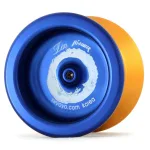
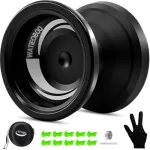
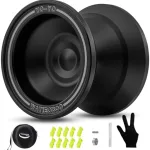
These Limited Edition Droids are the last yo-yos of the Droid line. There are two colorways of this final release.
The first is a “Droid X” colorway with rainbow iridescent stainless steel rings.
The second has jet black stainless steel rings and is named “Droid 9E”, a tribute to the black-plated BB-series astromech droid last seen in the Star Wars sequel trilogy.
The package includes the same delirium canister and accessories as the regular edition Droid.
The name Droid 9E was inspired by BB-9E, a black-plate BB-series astromech droid in the service of the First Order, from the latest Star Wars sequel trilogy.
I am not a sushi connoisseur but definitely a sushiholic. Like most of you, I would be more than satisfied with a simple pre-packaged sushi roll from the supermarket! My love for sushi stems from my fondness for Japan. In 2015, I proposed to my then-girlfriend on top of the Tokyo Skytree and attended the World Yo-Yo Contest. Fast forward to 2019, with a 6-month old toddler in tow, our little family toured the beautiful cities of Kyoto and Osaka. I am definitely going back to Japan when travel restrictions ease.
A sushi chef inside Sushi Dai.A long queue outside Sushi Dai.Inside the Tsukiji market, which has since relocated.
Japanese sushi chefs’ love and respect for sushi preparation are awe-inspiring. Often lauded for their culinary excellence, they are immensely passionate about their craft and spend years honing their skills. You would easily find a delicious sushi meal in any random restaurant in Japan.
I have adopted a similar mindset for all RSO releases so far. RSO yo-yos are prototyped extensively, and the journey is comprehensively documented. Considerable time is also spent on the story, artwork, engraving, accessories and packaging for each release. These add production costs to each yo-yo, but RSO has been able to keep its prices similar to (if not lower than) many companies who mainly sell bare-bones titanium yo-yos today.
For an RSO yo-yo named Sushi, the intricate details had to be absolutely perfect.
My then-fiance (now wife) in Sushi Zanmai.
LET’S ROLL
Production Sushi yo-yo.
Since the release of Gravity, I have been brainstorming for unique shapes that differ from the primarily organic RSO lineup. One of the most coveted RSO yo-yos is the titanium Bowl: Japan Edition, which had a ramen theme. Naturally, making a second yo-yo inspired by another Japanese food staple was always on the cards.
This may sound ridiculous, but I went to great lengths to ensure that the yo-yo halves would look like they were cut from a sushi roll. The pieces form a cylinder when lined up together.
Forming a Sushi roll with Sushi halves.
Why did I choose disc Side Effects (SE) for Sushi?
Disc SE are the only ones suitable for Sushi, as any other SE would reveal the hub and make the yo-yo look… “un-sushi-like”. A piece of sushi does not have a nipple in the center. Note that while disc SE fit the overall Sushi look, the same cannot be said for most other yo-yos (particularly V-shaped ones like Droid).
Moreover, it has been a long time since One Drop released a yo-yo that ships with disc SE. A yo-yo equipped with disc SE would have a novelty factor and would have some appeal.
The disc SE are one of the heaviest SE available at 7.2g and only come in aluminium. One Drop does not make them in brass for obvious reasons. Even with disc SE installed, the shipping weight of Sushi is a very delectable 63.7g, due to the relatively low base weight of the yo-yo halves. With aluminium ultralight SE (2.5g) installed, Sushi weighs a mere 59.0g.
Having a palatable weight is a fundamental requirement for any yo-yo. Caps play an essential role in weight variation and changing the playfeel of the yo-yo, in addition to their ancillary function of improving the yo-yo’s aesthetics. I did not want Sushi to weigh a hernia inducing 70g with the caps installed. With aluminium ultralight SE and the heaviest caps available installed, Sushi only weighs 64.6g.
Sushi is not a rim-weighted yo-yo, less so than Gravity. I designed Gravity to closely match the Freehand 1’s weight (65.8g) with aluminium ultralight SE, and the Freehand Zero caps (2.7g each) installed. Sushi had to weigh less to avoid a “heavy” playfeel. Each half of Sushi is almost 1g lighter than a Gravity half.
The magical thing about disc SE is that because they are so heavy and have a much broader profile, swapping them out for another SE changes the yo-yo’s playfeel significantly more than other SE types.
With the included disc SE, Sushi plays unhurried, controlled and steady, just like an omakase meal you would have at a top tier Michelin starred sushi restaurant. I would describe the playfeel as “floaty”.
However, suppose you want a quick sushi fix; simply swap out the disc SE for aluminium ultralight SE (not included). Sushi weighs a mere 59.0g in this configuration and plays zippy and light, and is bound to instantly satisfy your sushi cravings.
Don’t be fooled by Sushi’s squarish shape – it is pretty comfortable to hold. Despite its reasonably high walls, it has a generous gap and handles multiple string layers effortlessly. It is also one of the more stable RSO throws so far. Without having to consciously try to ensure that the yo-yo does not tilt, you can be fully focused on the gastronomic experience.
DANCE TO A DIFFERENT TUNA
The Sushi shape might look simple, but it is one of the yo-yos I spent the most time prototyping after Doombot and Droid. My insistence on retaining the cylindrical shape was the root of all the problems.
52mm 6061 aluminium Sushi prototype with a hollow construct.
Sushi started out as a 52 mm diameter aluminum yo-yo with a hollow construct. My initial plan was anodize the caps in different colors to match typical sushi ingredients (for example, yellow for tamago, pink for sashimi and orange for uni). I could do a fairly large run and price them low so that more people would be able to own an RSO.
The caps were CNC machined out of 6061 aluminium, and measured 1 mm at their thinnest portions. They were also made marginally bigger than the cap grooves, allowing them to be pressed fit into the yo-yo firmly.
The aluminium prototype failed miserably. The yo-yo was smooth if assembled without the caps, but installing the caps would introduce intolerable pulse vibe. It was the most vibey prototype since I started making yo-yos. The problem was that the caps were too thin and had warped during the machining or press-fit process. This prototype plays extremely floaty.
Spaceship (left), a 54 mm diameter yo-yo, next to the aluminium Sushi prototype (right), a 52 mm diameter yo-yo. Photo by Shimon Osada (@shimoff_2).
The solution seemed simple initially – just make the caps thicker! However, I could not remove enough weight from the yo-yo body to redistribute to the caps after countless attempts. In addition, the inherent cylindrical shape of the yo-yo necessitated a significant amount of material at the yo-yo’s rims since the rims extend outwards to span almost the entire width of the yo-yo. Conversely, a V-shaped yo-yo with similar dimensions would take up less weight (if you find it hard to visualize this, just compare the volumes of a cylinder and a cone).
Sushi was only possible with a titanium SE design, which allowed for retention of a similar aesthetic with caps installed. As much as I love how yo-yos play in titanium more than aluminium, there was a lot of inertia to take this route because the small size of the market for such a peculiar shape. Would anyone buy a titanium yo-yo with a squarish shape? I decided to bite the bullet anyway, ultimately making a small run of 62 yo-yos.
52mm titanium Sushi prototype. Note the different engraving from the production version.
The titanium prototype had one thing I did not like – its size. It felt large in the hand at 52 mm, and… wait for it… it was not small enough to look like a convincing piece of sushi (you must be tired of my obsession with making the yo-yo look exactly like a piece of sushi by now). The 52 mm diameter also made the disc SE look relatively small and not “fill” the hub.
Ideally, I would have liked the yo-yo diameter to be 50 mm. However, I wanted to make the accessories backwards compatible with Gravity and was constrained by the 48 mm diameter of the Freehand Zero caps. Sufficient material is needed at the cap groove for the yo-yo to be machinable. I eventually settled for a 50.5 mm diameter for the production version of Sushi, with the thickness of the cap groove measuring a safe 1.25 mm.
Before I put Sushi into production, a final prototype with a 50.5 mm diameter was made.
From left to right: 52 mm titanium prototype, 50.5 mm production version, 52 mm aluminium prototype.
TASTES BETTER, TOGETHER
I spared no effort in creating the complete package for Sushi.
Like Gravity, Sushi comes with a set of rings and caps, allowing for weight variation. Due to the collaborative nature of the Gravity project and associated cost constraints, a full set of custom CNC machined polycarbonate rings was only included with the Lunar Edition Gravity. This time, the full set is included with every Sushi, at a lower price compared to Gravity.
The components included with Sushi are as follows:
Yo-yo body, 53.7g
RSO CLYW Slim / G-grip Sized Landing Pads and Yoyorecreation NSK platinum double straight C Bearing, 2.3g
Aluminium disc One Drop SE, 7.2g
Pair of rubber cylindrical weight rings, 3.6g
Pair of custom polycarbonate thin rings, 2.8 g
Pair of custom polycarbonate thick rings, 4.4g
Pair of custom polycarbonate caps, 5.6g
Pair of FHZ caps, 5.4g
From left to right, custom CNC machined thin weight ring (1.4g), thick ring (2.2g) and cap (2.8g)
The polycarbonate rings and caps were custom CNC machined to achieve a perfect fit. They have a slightly different design compared to the ones included with Gravity. The hole in the center of the thick rings measures about an inch, which is a hair wider than the disc SE and allows the SE to pass through.
The weight rings, weighing 1.8g each, sit just underneath the caps. Sushi uses the same rubber weight rings as Gravity and the titanium Silver Bullet.Thin polycarbonate weight ring, weighing 1.4g each.Thick polycarbonate weight ring, weighing 2.2g each.Polycarbonate cap, weighing 2.8g each.
Three pairs of meticulously designed stickers were produced. They fit perfectly on the included polycarbonate caps to make your yo-yo look exactly like a piece of sushi.
Blank Freehand Zero caps, weighing 2.7g each.
FEAST YOUR EYES
The artwork is by RSO’s resident artist, ATILA.
The cover star is a sumo wrestler inspired by one of my favorite Street Fighter characters of all time, E-Honda.
For the side flaps, I referenced a few scenes which depict the sushi-making process from the movie Jiro Dreams of Sushi. Despite being in his late nineties, its chef Jiro Ono is still involved in the restaurant’s daily operations.
Special thanks to RSO’s long time friends, Yuuki Yoneno (@ynnyuux) and Shimon Osada (@shimoff_2), who helped with the Japanese banners in the background.
Sushi includes a redesigned cap removal tool. The new tool is longer, which allows the caps to be removed easily.The enamel pin features a hangiri, a traditional tub used to mix sushi rice.The certificate of authenticity features an oroshigane, used for grating wasabi.
WHAT’S IN THE BOX
A PAIR OF POLYCARBONATE CAPS
A PAIR OF THICK POLYCARBONATE RINGS
A PAIR OF THIN POLYCARBONATE RINGS
A PAIR OF DUNCAN FREEHAND ZERO CAPS
A PAIR OF RUBBER WEIGHT RINGS
NEW IMPROVED CAP REMOVAL TOOL
OROSHIGANE Certificate of AUTHENTICITY
HANGIRI ENAMEL PIN
RICE PRINT PROTECTIVE CLOTH
CLYW SLIM / G-GRIP SIZE WHITE TYPE 50 RSO LANDING PADS
“MK1 YoYos teams up once again with Spinworthy to bring you a fresh take on the beloved RBC—this time in plastic!
The Plasm is a polycarbonate yo-yo built for responsive play. Featuring a translucent, multi-piece construction, it offers a lightweight yet durable design that’s perfect for everyday throwing. Whether you’re working on classic tricks or just want something fun to carry on the go, the Plasm delivers smooth performance with a nostalgic feel. A modern responsive yo-yo designed to go wherever your creativity takes you.”
The following is archived from the Yoyofriends website:
The Story of Netrunner
Netrunner ushers in a new competitive era for yoyofriends and team yoyofriends players. The concept of this yoyo actually started around mid to late 2024. At that time we were trying to have design candidates for the 9th anniversary yoyofriends yoyo. One of the candidates is an ultra competition bimetal that focuses on power, width and stability. Traditionally, an anniversary yoyo for yoyofriends is cheaper compared to our normal releases. We would use simple design queues with a twist for easier machining. So for the overall shape, we just went with a classic V shape profile besides the SS rings. At that time, we just released our best competition budget monometal yet, the Ultracut. One of the many things we liked about that yoyo is the dimensions.
The wide width and slightly larger diameter really made hitting zoning tricks and long combos easier. So for this bimetal, we made the width and diameter the same as the Ultracut. Next is the material construction, we want to still push the design of this yoyo, experiment with new material options while making the price not super high. 7075 came to mind as we usually do 7068. 7075 has always been a material we want to try and master. We decided this project will be a great opportunity. Finally, the SS ring. This is what makes this project so special. Traditionally we use a wrapped around ring on our highest premium bimetal yoyos, examples of which are the Hummingbird, Peregrine X and tachyon. This time we want to try something new. Utilizing a hollow wrapped around stainless steel ring for the first time ever in our lineup. With all the parameters set, we made our first prototype.
(Picture of Netrunner prototype 1)
(Picture of Netrunner prototype 1 and Ultracut)
The prototype played very well. It has hit and surpassed just about every single metric of performance we expected. The yoyo is powerful, stable and still fast. The standout is how controllable the yoyo is, especially in horizontals. The yoyo holds itself in the air slightly longer than our traditional bimetals due to the hollow stainless steel rings. Overall we saw a significant improvement in overall comp meta performance over our previous bimetal model. The manufacturer team however found some issues. The weight of the prototype was all over the place, we really want to hit a more consistent weight for production. There are also a lot of vibey prototypes and the yield was not great. The manufacturing team has decided in order to solve this, we will make some slight tweaks on the design, ensuring a better weight consistency and ring fit. We ran into another issue as the cost of making this yoyo will be really high due to its wide body and hollow ring construction. With all these problems we decided to use hypercut as our 9th anniversary yoyo and further refine this project and make it a normal release as our next top competition model. Prototype 2 was then made.
(Picture of prototype 2)
The prototype 2 arrived and we solved all the problems above. We even increased its weight, doubling down on power. Somehow, increasing the weight slightly did not affect its speed and acceleration. We know from prototype 1 this is going to be one of the best comp yoyo in our lineup, so we made extra for yoyofriends players. James Heder and Stephen Madden switched to this model at PNWR (Pacific NorthWest Regionals). The best way to test a competition yoyo is always on the stage and this yoyo delivered big time. Both James Heder and Stephen Madden made finals with Stephen hitting a near flawless prelim and James getting 7th place in the finals for his first ever 3 min freestyle. The feedback from them was incredible. After this we greenlit this yoyo for production.
Here are the PNWR performances from Stephen Madden and James Heder using Netrunner at PNWR.
Recently, James Heder used Netrunner and won NER (Northeast Regional yoyo contest) 1A Finals! Further proving the competition readiness of the netrunner.
We also specially made signature colorway for our player Stephen Madden celebrating his years of contributions to team yoyofriend.
For the naming, we decided to use Netrunner, inspired by Cyberpunk 2077 (game) or Cyberpunk Edgerunner (show). Netrunner are cyber augmented hackers, dominating cyberspace. We think using this yoyo feels like hacking in a way for contests due to its sheer capabilities.
(picture of Netrunner in Cyberpunk 2077)
(Picture of production Netrunner)
(Picture of Stephen Madden -Netrunner Sig colorway)
It was March 2006 when two young gentlemen, Frank and Dom (then 21 and 19 respectively), met on the Team Yo-Yo Maniacs forum. A post made by Dom regarding the HSpin Pyro he just ordered was noticed by Frank, who had coincidentally purchased the Pyro that day. It was Frank’s first metal yo-yo while Dom was already an experienced metal and string wrangler.
A conversation between two yo-yo enthusiasts then followed (on the good ol’ ICQ), which blossomed into a friendship. Their first meeting was at Dom’s place. ILOVEYOYO (ILYY) was eventually formed in August 2006. Fun fact: the brand name was inspired by the PHP community site ILovePHP. The two were in constant in-depth discussion about their wish for an undersized yo-yo, which was not common on the market at that time. A few months later, they embarked on a journey to make a break-through undersized throw.
The initial renderings from Frank were disastrous – the machine shop had no clue on how to machine a yo-yo and translate the CAD into reality. Each yo-yo half (pictured below) weighed-in at only 15g!
Thankfully, the duo didn’t throw in the towel. After pushing out 4 more prototypes, they arrived at the lightest OG production version complete with glossy-shining orange and black halves in June 2007. The yo-yo was named “E1NS” and inspired by the German word for the number “1”… “eins.” The OG E1NS weighed a nimble 61.7g and was machined out of 7075 aluminium. With a diameter of 49.8 mm, width of 40.7 mm, and spinning on the not-so-familiar “L-size” bearing (also known as the ILYY KMK bearing), the run was a huge success. Only 57 yo-yos were produced, with 34 yo-yos sold via YoYoNation and the rest sold direct. Although the sale at YoYoNation caused pandemonium and crashed the site, the yo-yos still sold out within 15 minutes.
THE YO-YO
I had been in talks with Frank for a while even before I made my first model, The Bowl. I’ve always had great admiration for ILYY, especially their minimalist yet effective designs. Over the years, I had amassed quite a few of their models in my collection. When taking on the risky endeavor of producing my first throw, The Bowl drew heavy inspiration from the ILYY 2WEI’s signature hub and curved rims. The 2WEI remains my favorite ILYY model to date and is definitely a shelf topper in my collection.
One of our conversations led to the topic of an RSO x ILYY collaboration. I had initially wanted to work on the Wasabi or Trvth, while the guys wanted to do the DR3I. I’m not sure exactly how compromising and meeting in the middle led us to where we ended up, but I’m glad it worked out! We agreed to collaborate and revamp the most iconic ILYY model of all time and the one that started it all – the E1NS.
One thing we were instantly in full agreement on was that a titanium version of the E1NS was the best way forward. After a few days of brainstorming, I came up with the name E1NSTiEN. This moniker aptly incorporates the original yo-yo name, its German roots as well as its dramatic backstory.
The OG E1NS CAD was used as a starting point. We decided to keep the original diameter (50.0mm) and gap width (4.0mm) but upgrade the innards to a more modern axle and response system of M4 x 12 mm and 19mm, respectively. The prototype played amazingly, but we felt it was a tad too heavy at 62.2g. The hub on the prototype was also too prominent and looked dated. The final production model weighs 61.5g and features a lower peak at the hub. We kept the full aesthetics of the original and gave it a peppier engine and feel for those lucky enough to drive one!
P.S. The E1NSTiEN is powered by RSO’s proprietary Type 40 magenta LANDING PADS.
THE ILOVEYOYO HUB
This was perhaps the most challenging aspect of the project and, fortunately, I was able to meet the challenge head-on from my experience in designing and manufacturing The Bowl. There had to be a smooth transition from the base of the bump ascending up to its peak – an abrupt transition would result in the bump looking “separate” from the yo-yo. We literally spent hours tinkering with the transition and curves in the hub! We have our competent machinist to thank – he managed to nail our vision of the signature ILYY hub on the E1NSTiEN.
THE CYBERBRAIN
In a not-too-distant future, the ruling Council had been brainwashed by incompetent advisors who claim that yo-yos harm the community. They alleged that the collective creativity yo-yo’ing promotes encourages outliers that in turn threatens the ruling order of the Council. The dystopian leaders did the unimaginable: a ban was put in place, making the distribution and possession of yo-yos illegal. Yo-yo competitions were prohibited, and merciless bounty hunters contracted to round up and “dispose” of all yo-yo champions. They eventually succeeded in systematically disassembling the yo-yo community.
To archive the rich yo-yo trick library and avoid erasing the existence of yo-yo play, the Council had preserved the brain of the greatest yo-yo champion of all time. A staff of medical professionals tended round the clock to maintain the metabolism of the part human / part machine “Cyberbrain,” codenamed E1NSTiEN. The E1NSTiEN contained a crazed catalog of championship combo-winning tricks which challenge the very laws of physics, that only the uber-elitist yo-yo players could conceptualize. Residing in the most secure of security vaults, the holy grail was only accessible to a lucky few who knew the sacred number combination to the lock.
The Rebellion is lead by three handsome and dangerously masterful thinking men: Frank, Dom, and Elvin (not their real names, and any resemblance to anyone living or not living is purely coincidental). The coup d’etat dream team had been incubating and hatching a plan to break into the impenetrable vault. The plan would be dangerous but straightfoward to execute. By connecting themselves to the E1NSTiEN via the ports at the back of their heads, they could successfully hack the “Cyberbrain”, steal its tricks, and deliver them back to the yo-yo community.
The fate of yo-yo’kind lies in the hands of these three brave men.
WHAT’S IN THE BOX
Certificate of authenticity IN THE FORM OF A SECURITY NUMBER PAD