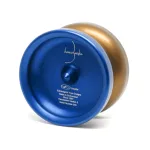
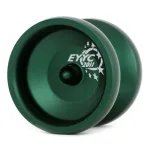
Forma

The following was archived from Editions YoYoExpert Forums post announcing the Forma:


Forma came to be due to a conversation with @fradiger and our shared love for mid-school throws. We were reminiscing about mid-school and modern designs and got talking about blending a few designs into something different:

  • CLYW Chief
  • Ikimono Tomo
  • OneDrop Cascade
  • YYR x OneDrop SYFO

A few messages later, Frad dropped this photo with the following quote:

“Theres a good yoyo in there, somewhere, because i like all these yoyos.”

The first concept would feature a polycarbonate inner ring forming a double rim, paired with a TP x CLYW-inspired profile. However as the vision evolved—leaning more into the Cascade and SYFO influences—we scrapped it for a cleaner monometal approach that better fit the SYFO/Cascade direction: MMP-01

MMP-01 final renders prior to prototyping:

Sadly MMP-01 wasn’t it though. It couldn’t handle impacts and vibed slightly from factory, so we went back to the drawing board. Enter MMP-02, later named Forma.

Forma went through three rounds of prototyping across three different shops: one in the U.S. (@Lotaxi), one at FPM, and one at TopYo. Around that time, there was a lot of behind-the-scenes chatter about inconsistent lead times, machining quality, and communication issues with OEMs. It felt like the right moment to test the waters and get a firsthand look at how each shop handled the process.

Although we would go on to prototype in both 7068 and 6061, the 6061 version just felt right—durable, comfortable, and locked into that midschool-inspired vibe that put feel first. Let’s be real—this wouldn’t be an Edition yo-yo if it didn’t still pack performance as a mainstay trait.

The result?

Forma is about execution—pacing your tricks, constructing with intention, and feeling the flow in your play. It packs power so that it doesn’t demand perfection, but it shines when your execution is clean and your transitions are thoughtful.

Available now on the Edition Yoyo storefront with the following colors:

We hope you enjoy as much as we did putting this together!

Bowl Mini Titanium

A NEW TITANIUM SIBLING

Since the original Bowl in August 2018, RSO has produced many iterations of the Bowl series in different sizes and metal alloys. Apart from YoYoFactory, which has made aluminium, stainless steel and titanium versions of the legendary 888, no other yo-yo has been given the same treatment. Given the popularity and success of the stainless steel and aluminium Bowl minis, a titanium version was planned.

RSO has been searching for a new machinist for the past few months to avoid over-reliance on a single factory. The Bowl mini titanium was deemed as a low-risk project to test the quality of our new machinist.

The two previous stainless steel versions were tricky to machine due to their paper thin walls, but the yo-yos turned out to be largely vibe-free. Naturally, a titanium version with thicker walls was expected to be more reliable to machine. In addition, the small 50mm diameter of the Bowl mini further lowers the risk of B grades.

I decided not to attempt a stainless steel version of the larger regular Bowl at that time as it would be a far riskier project, especially with a new machinist on board, but that’s a story for another time.

The success of the Bowl mini titanium run allowed me to price it competitively and retain all the artwork and goodies RSO is known for.

IDENTICAL TRIPLETS

The stainless steel, aluminium and titanium Bowl minis are like identical triplets. They might look similar but have entirely different personalities.

Their catch zones are photocopies of each other, they all have a subtle bump at the hub (a genetic trait of the Bowl series), and they weigh almost the same. But their similarities end here.

Let me teach you a trick to tell them apart – focus your eyes on their rims, and you’ll immediately notice that the titanium one’s rims are about twice as chubby as its stainless steel brother but still much slimmer than its aluminium brother. The aluminium sibling also has a more extroverted, colorful persona.

CHARACTER ANALYSIS

The siblings have contrasting characters. The titanium one behaves more slow-going and measured compared to its nimble and speedy C bearing stainless steel one. Compared to its D bearing stainless steel and aluminium brothers, the titanium one is more cautious and lands more softly and carefully at the end of the string. The titanium sibling is the child you won’t have to worry too much about.

The siblings sound vastly different – they could form a perfect vocal group. The stainless steel one would be the tenor, the titanium one the baritone and the aluminium one the bass.

From left to right: Bowl XL, Bowl mini titanium, Bowl Japan Edition.

CONCEIVING THE YO-YO

I first prototyped Bowl mini titanium about 9 months ago (yes, it is a full term baby). Both C and D bearing versions were made.

Unlike TiRAMiSU where it was a close fight between both versions, the C bearing version for the Bowl mini titanium was a clear winner – it had a more floaty play-feel, felt lighter and seemed infinitely more special.

The D bearing version had a far too solid and heavy play-feel. It felt almost sluggish. The more rim weighted weight distribution compared to the D bearing stainless steel Bowl mini also resulted in intolerable kickback. I could not bring myself to like it even after throwing it for months.

I ultimately decided to put the C bearing version into production, not before shaving off about 1.5g of the weight from the rims of the prototype.

D bearing (left) and C bearing (right) Bowl mini titanium prototypes.

WHAT’S IN THE BOX

Certificate of authenticitY

STUFFED TOY ROBOT ENAMEL PIN

A PAIR OF 19MM CYAN TYPE 50 LANDING PADS RESPONSE

RED STRING

The Bowl mini titanium is the last yo-yo of the Bowl mini line. The artwork by Pingolito again features my elder son, Isaac Lim, as the cover star. We decided go for the “plush toys” theme.

From left to right: stainless steel, aluminium and titanium Bowl mini boxes.

BUN IN THE OVEN

Bowl 303

ENGINEERING MARVEL

Back in 2019, when I wanted to make a stainless steel yo-yo, on the top of my list was a full-sized stainless steel Bowl. However, as my machinist had yet to attempt a stainless steel yo-yo, I decided put the less risky 50 mm diameter Bowl Mini into production instead. Apart from the TopYo Top Steel, which was a full-sized yo-yo with a 56 mm diameter, stainless steel yo-yos were all in the undersized or micro category at that time. Honourable mentions include the ILoveYoYo Saint Eel (42 mm), Luo Yicheng Kun (27 mm) and YoYoFactory Mighty Flea (25 mm).

Stainless steel is such a complex material to work with primarily due to its high density. Fun fact: the densities of the titanium, stainless steel, and 7068 aluminium RSO typically uses when designing yo-yos are 4.51, 7.65 and 2.81 (in g/cm3), respectively. With such high density, there is drastically less room for maneuverability. As a result, simple design elements like a nipple or inner ring grind would dramatically increase the yo-yo’s weight. Removing weight from other areas poses a considerable challenge – no matter how you thin down various parts, the yo-yo is still a hefty unplayable paperweight.

Three years have passed and many companies have embraced the alloy. To my knowledge, there have been 3 full-sized stainless steel yo-yos so far, namely, the YoYoEmpire Thorest, TopYo Top Steel and Hydrangea Lisanthus. Note that they have a general V (Thorest, Top Steel) or W (Lisianthus) shape, as depicted in the images below (pictures from Spingear and YoYoExpert). The designs of these yo-yos are commendable. The Lisianthus deserves a special mention – it manages to squeeze in a nipple, have a W shape and maintain a palatable weight. However, Bowl 303 goes one step further.

YoYoEmpire Thorest, 67.9g
TopYo Top Steel, 65.8g
Hydrangea Lisianthus, 68.2g

You are probably no stranger to the organic shape of the Bowl series. Making an organic shape stainless steel yo-yo is far more complicated than, say, a V-shaped one. The reason is simple: an organic-shaped yo-yo is bigger by volume than a V-shaped one. For the same weight, the walls have to be machined thinner. Bowl 303 weighs only 63.7g and is the lightest amongst the aforementioned full-sized stainless steel offerings. A fortunate thing about the Bowl 303 design is that a protruding nipple or deep groove, which would otherwise have added weight, was not necessary.

Bowl 303 has the thinnest walls of any RSO yo-yo ever made.

In case you’re wondering how the Bowl 303 got its name: the alloy used to machine the yo-yo is 303 stainless steel.

P.S. The yo-yos of this run will not be individually numbered.

SAME LOVABLE BOWL

Although the general shape of Bowl 303 is identical to the other yo-yos in Bowl series, the weight distribution is vastly different.

For the Bowl Mini, the stainless steel version is essentially a thinned-down version of its titanium and aluminum versions, with each part of the yo-yo thinned down proportionately. The difference in playfeel between the Bowl Minis was thus solely attributed mainly to the different materials and resultant change in weight distribution.

With the full-sized design of the Bowl 303, limited by the high density of stainless steel, I could not thin down the walls of the yo-yo proportionately from its titanium and 7068 aluminium counterparts. There just wasn’t enough material to play around with. In terms of weight distribution, Bowl 303 has more center weight than its predecessors.

Playfeel-wise, Bowl 303 plays slower, is more laid back and is easier to control than its similar-sized counterparts. Given the difference in both material and weight distribution, it is hard to say which is the dominant factor contributing to the different playfeel. I made the rims more rounded (and consequently slightly thicker) than the stainless steel Bowl Mini, so the yo-yo feels more comfortable in hand.

POLISHED BEAUTY

Bowl 303 is polished to almost a mirror finish – you can see your reflection clearly. The stainless steel looks more premium with a mirror finish than a brushed finish. Although production costs were increased, the finish on Bowl 303 stands above the rest.

ART BY JASON WEEK AND ATILA

The artwork is by Jason Week, with additional elements by ATILA. Additionally, it features a familiar sloth with a bowl cut, Owen, seen on the artwork of previous full-sized Bowl releases.

WHAT’S IN THE BOX

BOWLING SLOTH ENAMEL PIN

A PAIR OF 19MM CYAN TYPE 50 LANDING PADS RESPONSE

RED STRING

The Martian!

MARTIAN INVASION!

As we approach the end of 2022, I reflect on RSO’s year which has been relatively uneventful, with only 6 releases compared to the 16 in 2021.

It has been slightly over 4 years since RSO’s first yo-yo, and manufacturing costs have increased tremendously. Although it no longer makes financial sense to continue operating RSO, my passion for yo-yo design has been crucial in keeping the company going. In addition, I still enjoy brainstorming the theme and artwork behind each model, particularly for models like Sushi and now The Martian!

The Martian has been a long time in the making. The prototypes were completed in January 2022, and the production batch shipped to me in June 2022. Unfortunately, the release was delayed indefinitely due to a critical manufacturing defect in the Side Effects (SE) hole. The SE could not fit, and the yo-yos had to be redone.

I am glad to finally show you my creation six long months later.

This is a special yo-yo. It is difficult to accurately describe the playfeel of Martian – it is neither floaty nor solid playing, but it has plenty of… soul. If you’ve thrown a Canvas, which the Martian is heavily based on, you’ll know how it feels. The Martian plays slightly heavier with more center weight compared to the Canvas, with a very peculiar bounce when it hits the string. Every now and then, an RSO yo-yo with a seemingly simple design blows me away, and the Martian is one of them. It is up there with derti, TiRAMiSU and Sushi as my favorite RSO releases.

It must be emphasized that the yo-yo is not wholly vibe-free. I attribute this to the relatively large, full-sized diameter of the yo-yo, which increases the risk of warping during the machining process. The yo-yo is smooth on the string and outer rims but has a slight unnoticeable vibe if you place two fingers in the catch zone near the response area. I applied the same quality control standard as Gravity – so you would be happy with Martian if you were satisfied with your Gravity.

THE BIG BANG

Martian is a fusion between the RSO x Atmos Projects Gravity and CLYW Canvas.

The initial Martian CAD resembled more the Gravity than Canvas. I wanted the caps made for Gravity and Sushi to be backwards compatible with Martian, but it was impossible. The diameters of Martian, Gravity and Sushi are 55.5 mm, 54 mm and 50.5 mm respectively – the larger diameter of Martian meant that more material had to be located at the rims to accommodate the comparatively small caps, which resulted in an unacceptable increase in the yo-yo’s weight.

I felt that fabricating new, larger caps for the Martian would not be wise as the groove for the caps would only be compatible with one yo-yo, lacking versatility. On the contrary, the cap grooves on the Gravity and Sushi are more universal as they can also accommodate Freehand Zero caps.

The production version of the Martian has a Gravity-like hub and a similar curvature to the inner rim.

Gravity (left) and Martian (right).

After I removed the cap grooves, the Martian CAD evolved into one looking more like the Canvas than Gravity. The response grooves, surrounded by deep Schmoove grooves, accommodate CLYW / G-grip sized type 50 Landing Pads, with which I have a love-hate relationship.

On the one hand, the pads have a larger diameter and give the yo-yo slightly more momentum and longer spin time. On the other hand, they are thicker than your regular 19mm pads, necessitating more material in the center of the yo-yo to accommodate them. The broad and deep Canvas-like Schmoove grooves negated this issue in the Martian.

Gravity (left) and Martian (right).

The Martian has Canvas-like walls, which are higher than Gravity’s. The Martian is about 1 mm wider in diameter and width compared to the Canvas.

Gravity (left) and Martian (right).

The inner rims on the Martian also feature a triangular-shaped protrusion, similar to that of the Canvas. The outer rims, on the contrary, are slightly rounder than the Canvas. The Martian feels “fatter” in the hand.

Gravity (left) and Martian (right).
Canvas (left) and Martian (right).

The production version of the Martian is essentially a slightly wider, slightly larger diameter, plumper titanium SE Canvas with a Gravity hub.

UNPARALLELED IN THE GALAXY

As with all RSO SE models, Martian is powered by original One Drop SE and premium Yoyorecreation NSK platinum Double Straight bearings.

In addition to the brass ultralights SE installed, a pair of aluminium ultralights SE are included with every Martian. With aluminium ultralights SE installed, Martian weighs only 62.7g and handles fast trick combos better. However, I prefer the heavier playfeel with the brass ultralights SE installed.

I contemplated shipping Martian with Energy Dome SE, which resembles the muzzle of the Martian brain disintegrator from the film Mars Attacks!, but eventually decided against it as it didn’t fit the overall look.

MARS ATTACKS!

https://youtube.com/watch?v=BB61nauFkds%3Ffeature%3Doembed%26enablejsapi%3D1

The artwork was drawn by ATILA, a long-time collaborator of ours. ATILA and I are big fans of the Mars Attacks! movie and felt that we could do a spin on the art for The Martian! Despite an ensemble cast of A-listers, the film did not perform at the box office but eventually became a cult classic. On the cover, we have RSO’s ambassador, Hachiko, trying to defend planet earth from the attacking Martians.

WHAT’S IN THE BOX

A PAIR OF ALUMINIUM ULTRALIGHT SE (IN ADDITION TO THE BRASS ULTRALIGHT SE INSTALLED)

MARTIAN INVADER ENAMEL PIN

Certificate of AUTHENTICITY

A PAIR OF CLYW SLIM / G-GRIP SIZE TYPE 50 RSO LANDING PADS

RED STRING

Makisushi

Makisushi is a special edition of the hugely popular Sushi yo-yo, based on the same CAD. Sushi ranks amongst my top RSO releases, not only because of its unique playfeel but also due to my love for the sushi delicacy and Japanese culture.

The yo-yo was intentionally designed to resemble a sushi roll, which is also known as “makizushi” or “makisushi”.

The anodized black cracked hard coat finish on Makisushi is reminiscent of the seaweed, or “nori”, used to wrap around the sushi rice. The “cracks” on Makisushi have a gold hue, in contrast to the ones on the Mecha-Viszilla SE Edition, which have a silver hue. Unfortunately, I could not make a larger run of Makisushi due to the high-risk nature of the anodization process.

Fun fact: Nori comes in different grades. As a general rule of thumb, the darker the colour, the better. Higher grades have a jet-black hue.

Makisushi will ship with the same components included with the raw Sushi run.

Note: Due to this yo-yo’s anodized coating, the finish may wear if the caps and rings are repeatedly installed and removed. For the same reason, the caps and rings are also slightly tighter on Makisushi than its raw counterpart.