For a yo-yo to actually be a yo-yo, it has to come back. While spinning at the end of a string is a beautiful display of physics, the magic happens in the return. For decades, the mechanism that commanded the yo-yo to climb back up the string—the “response system”—was practically an afterthought. Today, it is a micro-engineered component that defines how a yo-yo plays.
As the yo-yo evolved from a simple up-and-down toy to a freely spinning, ball-bearing-equipped instrument, the response system had to adapt. Here is the history of the friction that brings it all back home.
The Natural Era: Fixed Axles and Cotton
In the early days of wooden yo-yos, there was no separate response system. The axle itself, firmly fixed to the two halves of the yo-yo, did all the work.
When you threw a wooden yo-yo, the cotton string looped around the wooden axle would grip just enough to allow it to “sleep” (spin freely). When you gave the string a sharp tug, the momentary slack allowed the cotton fibers to catch on the spinning wood, winding the string and forcing the yo-yo back to your hand. It was an elegant, simple system, but it was limited by friction—too much grip and the yo-yo wouldn’t sleep; too little, and it wouldn’t return.
The Mechanical Leap: Starbursts
The revolution came in the 1990s with the widespread adoption of the transaxle and, eventually, the ball bearing. Suddenly, yo-yos could spin for minutes with practically zero friction. However, this created a new problem: the yo-yo was too smooth. Tugging the string did absolutely nothing.
To solve this, manufacturers molded Starbursts into the plastic halves of the yo-yo. These were raised, star-shaped ridges radiating outward from the center bearing.
- How it worked: When the string was pulled, the slack would briefly touch these plastic teeth, catching the string and winding it up.
- The drawback: Starbursts caused the string to wear out rapidly due to the aggressive plastic teeth constantly chewing on the fibers.
The Custom Grip: Brake Pads and Friction Stickers
As tricks became more advanced, players wanted smoother spins without the loud, grinding feel of starbursts. Enter the replaceable response system.
Pioneered by companies like Playmaxx (makers of the legendary ProYo and Bumblebee), Brake Pads were small die-cut rings of cork or rubberized cloth that stuck to the inner walls of the yo-yo around the axle.
- The Advantage: They provided a buttery-smooth sleep, but grabbed the string fiercely when tugged.
- The Legacy: This shifted the paradigm. Response systems became a “wear item” that players had to replace regularly, much like changing strings. It also allowed players to customize their yo-yo by using thicker or thinner stickers.
The Hybrid Era: Rubber O-Rings
In the early 2000s, yo-yo design was in a transitional phase. Players were experimenting with wider gaps and thicker strings. YoYoJam, a major innovator of the era, popularized the use of thick Rubber O-Rings seated inside a groove on the yo-yo wall.
O-rings offered an incredibly durable response that rarely needed replacing. They sat flush (or slightly protruding) from the yo-yo wall, providing a snappy return. However, as playstyles shifted toward highly complex string layering, thick rubber o-rings proved too “grabby,” often causing the yo-yo to return unexpectedly and hit the player in the knuckles.
The Modern Standard: Silicone and Unresponsive Play
Today, the yo-yo world is dominated by “Unresponsive” play. Modern yo-yos will not return to the hand with a simple tug; they require a specialized string trick called a “bind” to force the string into the response system. For this to work perfectly, the response system must be completely flush with the yo-yo wall, providing zero friction during a sleep, but absolute grip during a bind.
Silicone proved to be the ultimate material.
- Flowable Silicone: Early innovators literally used tubes of automotive windshield sealant, pouring liquid silicone into a recessed groove in the yo-yo and letting it cure overnight.
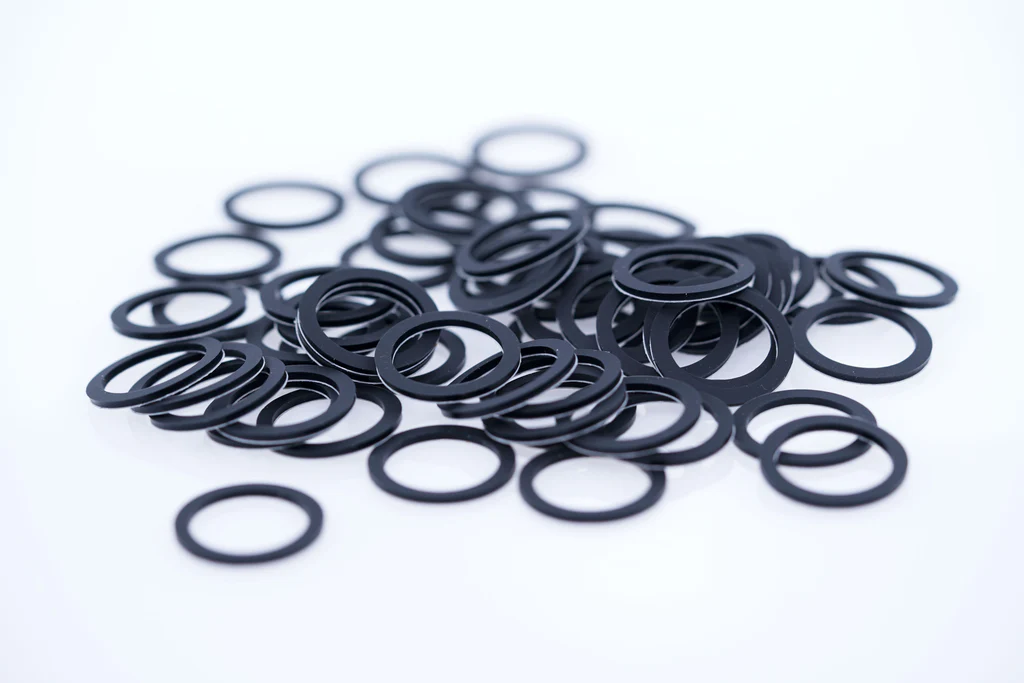
- Pre-Molded Pads: Today, manufacturers produce standardized, die-cut silicone pads (often called CBC pads, Snow Tires, or Slim Pads). They are backed with adhesive, snap perfectly into the yo-yo’s recess, and offer the absolute pinnacle of smooth, reliable, and bind-ready friction.
A Century of Response at a Glance
| Era | Response System | Primary Material | Defining Characteristic |
| Pre-1990s | Fixed Axle | Wood & Cotton | Relied entirely on the natural friction between the string and axle. |
| Early 1990s | Starburst | Molded Plastic | Raised, aggressive ridges that mechanically grabbed the string. |
| Late 1990s | Friction Stickers | Cork / Cloth / Rubber | Replaceable, customizable pads that allowed for smoother sleeping. |
| Early 2000s | O-Rings | Solid Rubber | High durability and a very snappy, immediate return. |
| 2010s-Present | Silicone Pads | Molded Silicone | Completely flush, designed specifically for unresponsive bind returns. |