Executive summary
The rivalry between YoYoFactory (YYF) and One Drop YoYos is among the most consequential cultural and industrial conflicts in modern yo-yo history. Originating during the transition to unresponsive, high-performance metal yo-yos (2007–2009), the clash was fueled by three interconnected flashpoints:
- Design lineage disputes: the controversy surrounding the unreleased Buzz-On DV8, One Drop’s The Project, and YoYoFactory’s DV888.
- Economic disruption & retail wars: One Drop’s domestic $60 price point collapsing the high-end metal market margin, leading to distributor pressure.
- Contrasting manufacturing philosophies: globalized, contest-driven mass production versus localized, machinist-led craft.
Act I: The unreleased precursor (the Buzz-On DV8)
In the mid-2000s, competitive yo-yoing was moving beyond plastic hybrids. Buzz-On Industries—co-founded by Dave Bazan and Dave Muehlhaeusler (popularly known as Dave Lahr)—held a central place among enthusiast modders.
Pre-production run limited by patent disputes
- Colin Leland & Shawn Nelson CAD
- Aerospace hex-nut axle capture
- $60–$75, domestic in-house CNC
- Officially licensed from Buzz-On
- Blended with 888 profile
- Global mass-production run
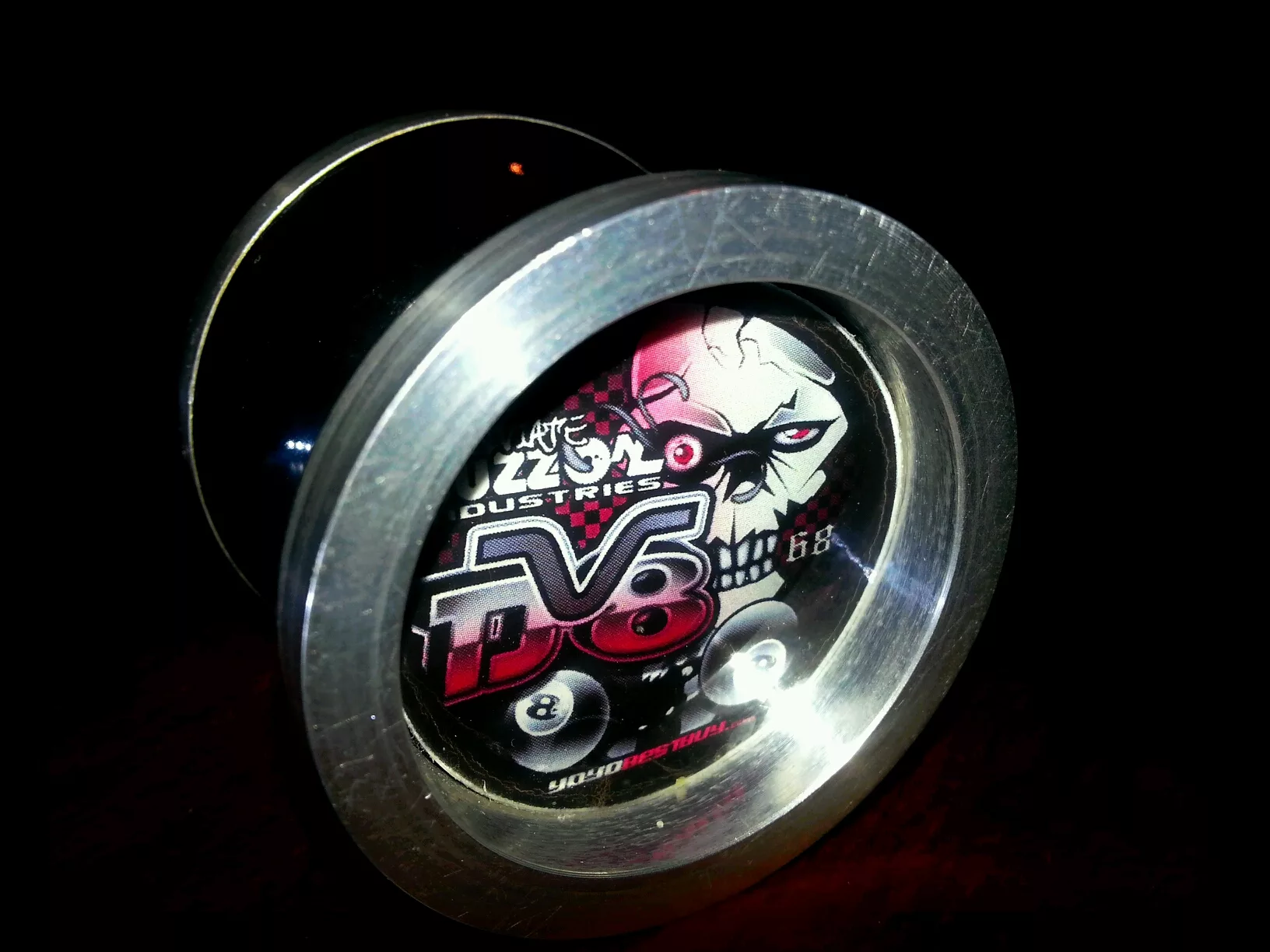
Buzz-On developed a pre-production all-metal, compact prototype with broad, flat rims called the DV8. However, due to industry patent disputes regarding weight-ring distribution (most notably YoYoJam’s patent on plastic bodies with denser outer rims) and manufacturing hurdles, the DV8 never reached full commercial release; only roughly 100 numbered pre-production units were made. Despite its limited run, the compact, rim-weighted silhouette became legendary among competitive throwers.
Act II: The student, the machinist, and The Project (2007)
One Drop Design began in 2001 in Eugene, Oregon, as a contracting machine shop founded by Shawn Nelson and David Metz. While they had considered machining yo-yos as early as 2002, the project only materialized in 2007 when Colin Leland, a University of Oregon student, walked into their shop with a yo-yo concept.
| The Project’s design DNA | |
|---|---|
|
Colin Leland (Designer) |
Shape concept, silicone pad recess, perimeter rubber nubs, named “Project” (to cast light) |
|
Shawn Nelson (Lead Machinist) |
Aerospace-derived hex-nut capture system (“Never thread directly into aluminum”) |
|
Mark Montgomery (2003 AP Champion) |
Influenced design tastes via former Buzz-On sponsorship; led to 2008 MarkMont Project |
Deconstructing the “copy” myth
Community rumors long maintained that One Drop simply duplicated the Buzz-On DV8 without permission. While the aesthetic similarities were undeniable, the engineering reality differed:
- Aerospace axle architecture: Shawn Nelson noted that because of his background in aerospace manufacturing—where threading steel hardware directly into soft aluminum is avoided—he insisted on an internal nut capture system. When proposed, Leland famously asked, “How do you drill a hexagonal hole?!”
- Original geometry: Leland designed the profile, the silicone response grooves, and the signature push-in rubber rim nubs.
Addressing the legacy in modern retrospectives, One Drop co-founder David Metz explicitly stated:
“The Project was not a copy of the DV8.”
— David Metz (da5id), One Drop YoYos
The confusion was further amplified by Mark Montgomery (2003 AP World Champion). Formerly sponsored by Buzz-On, Montgomery was an outspoken advocate for the DV8’s profile. When Montgomery joined One Drop, his preferences helped shape the MarkMont Project (2008)—a widened, nickel-plated iteration—cementing the public association between the two companies’ designs.
Act III: The $60 disruption & retail cold war
When The Project dropped in late 2007, high-end aluminum metal yo-yos routinely retailed between $100 and $150. Brands relied on standard distribution models: boutique runs outsourced to third-party machine shops, marked up for wholesale, and marked up again for retail.
One Drop disrupted this pricing model:
- Vertical integration: because Nelson and Metz owned their CNC mill and lathe equipment, they eliminated third-party machining margins.
- The $60 price point: One Drop brought The Project to market at roughly $60–$75, proving that an American-made, high-tolerance metal throw could be sold at a fraction of the prevailing market rate.
This pricing strategy disrupted major distributors and established brands, particularly YoYoFactory, which was aggressively scaling its own global catalog.
According to long-standing industry accounts and retail retrospectives, YoYoFactory put significant pressure on specialized distributors (such as YoYoExpert). YYF allegedly threatened to pull its high-volume product line from retail shelves if stores carried One Drop, fearing that a $60 baseline for domestic metals would deflate wholesale margins and erode the premium image of existing competition lines.
Act IV: The counter-strike & the DV888 (2008)
Recognizing both the market appetite for compact, affordable metals and the lingering IP debates, YoYoFactory’s leadership (Hans Van Dan Elzen and Ben McPhee) executed a swift counter-strategy:
Positioned as the “official” successor to the Buzz-On DV8.
Mass-produced in China to dominate the sub-$50 market.
- Official licensing: YYF partnered directly with Dave Lahr/Buzz-On to formally license the DV8 name and design language, effectively branding their release as the sole “legitimate” successor to the lineage.
- Hybrid design: YYF merged the DV8 profile with elements from their flagship metal, the 888, producing the DV888.
- Mass production: unlike One Drop’s domestic machine shop model, YYF manufactured the DV888 in large quantities in China, driving the price down even further and turning the model into one of the best-selling metal yo-yos in history.
Act V: Two irreconcilable philosophies
The DV8/Project feud crystallized two fundamentally different visions of the modern yo-yo business:
| Structural dimension | One Drop YoYos | YoYoFactory |
|---|---|---|
| Machining model | 100% in-house CNC shop (Eugene, Oregon) | Global outsourced manufacturing (Shenzhen, China) |
| Axle engineering | Hex-nut capture → Modular Side Effects system | Standardized set screws & press-fit hubstacks |
| Market strategy | Small-batch enthusiast drops, community direct sales | Mass-market toy retail, contest sponsorships, global team |
| Brand ethos | Machinist-led, roots-inspired boutique | Competitive powerhouse, high-volume market saturation |
Cultural detail: the “One Drop” moniker
One Drop’s identity was rooted in independence. Founders Metz and Nelson, both former musicians in reggae bands, named the company after the “One Drop” rhythm—the signature roots reggae drum cadence popularized by Carlton Barrett of Bob Marley and the Wailers. As David Metz explained, the beat is “technically simple, but very difficult to play with the right feel”—a metaphor for their approach to CNC machining.