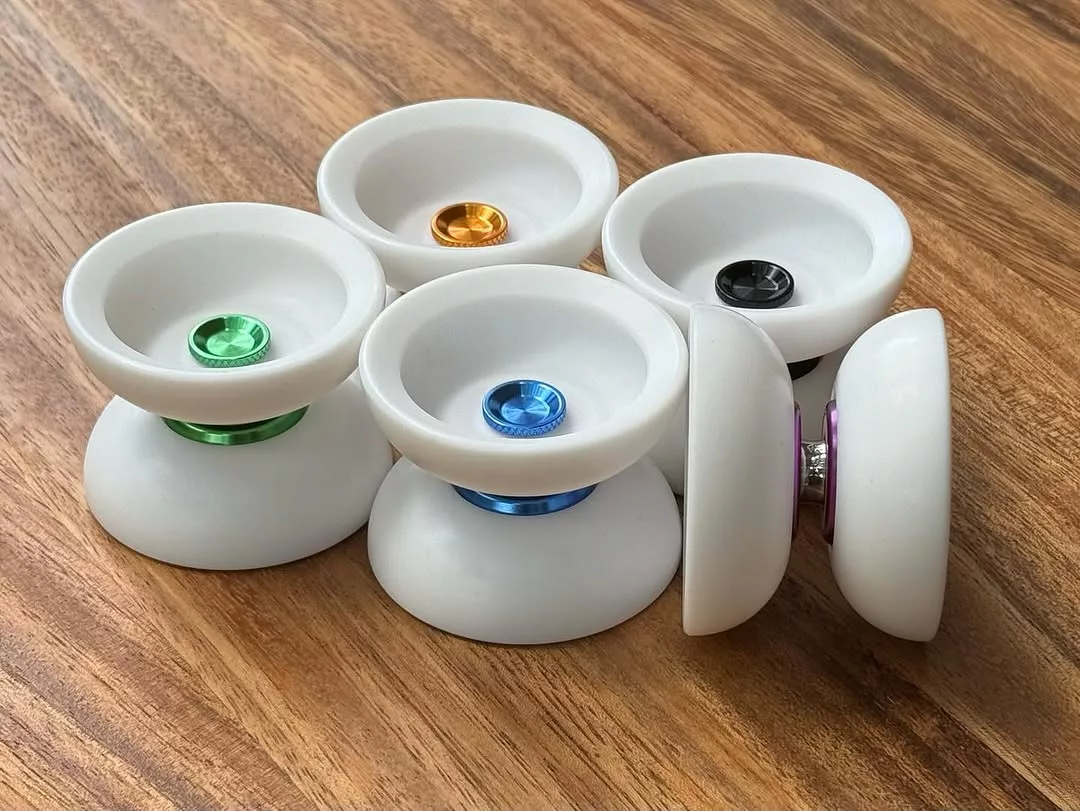
For as long as humans have been tossing spinning objects at the end of a string, the soul of a yoyo has been defined by what it is made of. The material dictates not only the weight and balance but the very sound, feel, and capability of the return top. From the earthy thud of catching a wooden classic to the high-pitched hum of modern aerospace-grade alloys, the evolution of yoyo materials is the evolution of the trick itself.
Here is the story of how the yoyo transformed from a simple wooden toy into a precision-engineered instrument.
The Wooden Era: The Roots of Spin
Before the mid-20th century, if you were throwing a yoyo, you were throwing wood. Historically, ancient yoyos may have been crafted from terracotta or stone, but the modern yoyo craze was built on the backs of hardwoods.
Manufacturers like Duncan and Flores relied heavily on hard maple. Maple offered a brilliant balance of durability and weight, and because these early yoyos featured a wooden fixed axle (the string looped directly around the wooden peg in the center), the natural friction of the wood was essential. It allowed the yoyo to sleep, but also gave it the “grab” needed to return to the hand with a simple tug.
Even today, fixed-axle purists seek out specific woods—like ash, mahogany, or walnut—for their unique aesthetics and play characteristics, cherishing the nostalgic, organic feel that only wood can provide.
The Plastic Revolution: Shaping the Future
As the 1950s and 60s rolled around, injection-molded plastics changed the world, and the yoyo industry eagerly followed suit. Plastic offered three massive advantages: mass production, unparalleled durability, and the ability to mold complex shapes.
- Polystyrene: Early plastic yoyos were often made of polystyrene. While slightly brittle, it allowed for the mass production of iconic models like the Duncan Imperial.
- Polycarbonate (Lexan): As string tricks evolved, players needed yoyos that wouldn’t shatter when hitting the ground. Polycarbonate, known for its incredible impact resistance, became the standard for heavy-duty play.
- Acetal/Delrin (POM): Later in the timeline, manufacturers turned to machined plastics like Delrin. Known for its extremely low friction and silky-smooth texture, Delrin is still used today to create premium plastic yoyos that rival the performance of metals.
The shift to plastic also allowed for the creation of the wide “Butterfly” shape, a structural innovation that would have been incredibly difficult and prone to breaking if carved from wood. This shape paved the way for modern string tricks.
The Age of Aluminum: Precision and Performance
The late 1990s and early 2000s marked the greatest leap in yoyo evolution: the popularization of the precision-machined aluminum yoyo. Once ball-bearing axles were introduced, players realized that spin times were no longer limited by axle friction, but by weight distribution and balance.
Metals allowed designers to push weight to the absolute outer rims of the yoyo, vastly increasing the moment of inertia and resulting in spin times that measured in minutes, not seconds.
- 6061 Aluminum: The workhorse of the modern yoyo industry. It is affordable, highly machinable, and takes anodization beautifully, allowing for the stunning colorways and splashes seen in modern collections.
- 7075 Aluminum: A denser, stronger aerospace-grade alloy. Because it is more rigid, designers can machine the walls of the yoyo incredibly thin, pushing even more weight to the rims for ultimate stability.
The Bimetal Breakthrough: Maximizing Rim Weight
If aluminum pushed the boundaries of rim weight, bimetal designs shattered them. In the 2010s, competitive players began demanding even more stability to execute highly complex, horizontal, and rapid-fire tricks.
To achieve this, manufacturers combined a lightweight aluminum body with dense, heavy rings made of Stainless Steel or Brass, press-fitted onto the rims. By using two different materials, designers effectively “cheated” physics, creating an extreme weight distribution that an all-aluminum yoyo simply cannot replicate. Today, bimetals dominate the competitive stage.
The Pinnacle of Premium: Titanium and Beyond
For the ultimate yoyo connoisseur, there is titanium. Titanium is incredibly strong but less dense than steel. Its exceptionally high strength-to-weight ratio allows designers to machine the walls of the yoyo to paper-thin tolerances (sometimes less than half a millimeter thick) without sacrificing durability.
Titanium yoyos are notoriously difficult and expensive to manufacture, but they offer a unique, floaty feel on the string and produce a distinct, resonant “ping” when they hit the end of the string. As a bonus, when sparked against concrete, titanium yoyos throw brilliant white sparks—a favorite party trick among brave collectors.
The Unending Cycle
The history of yoyo materials is a feedback loop: new materials unlock new designs, new designs inspire new tricks, and new tricks demand even better materials. Whether you are throwing a fixed-axle wooden classic on a lazy Sunday or competing on the world stage with a precision-machined titanium-stainless-steel marvel, you are holding a piece of history. The spin remains the same, but the canvas has forever changed.