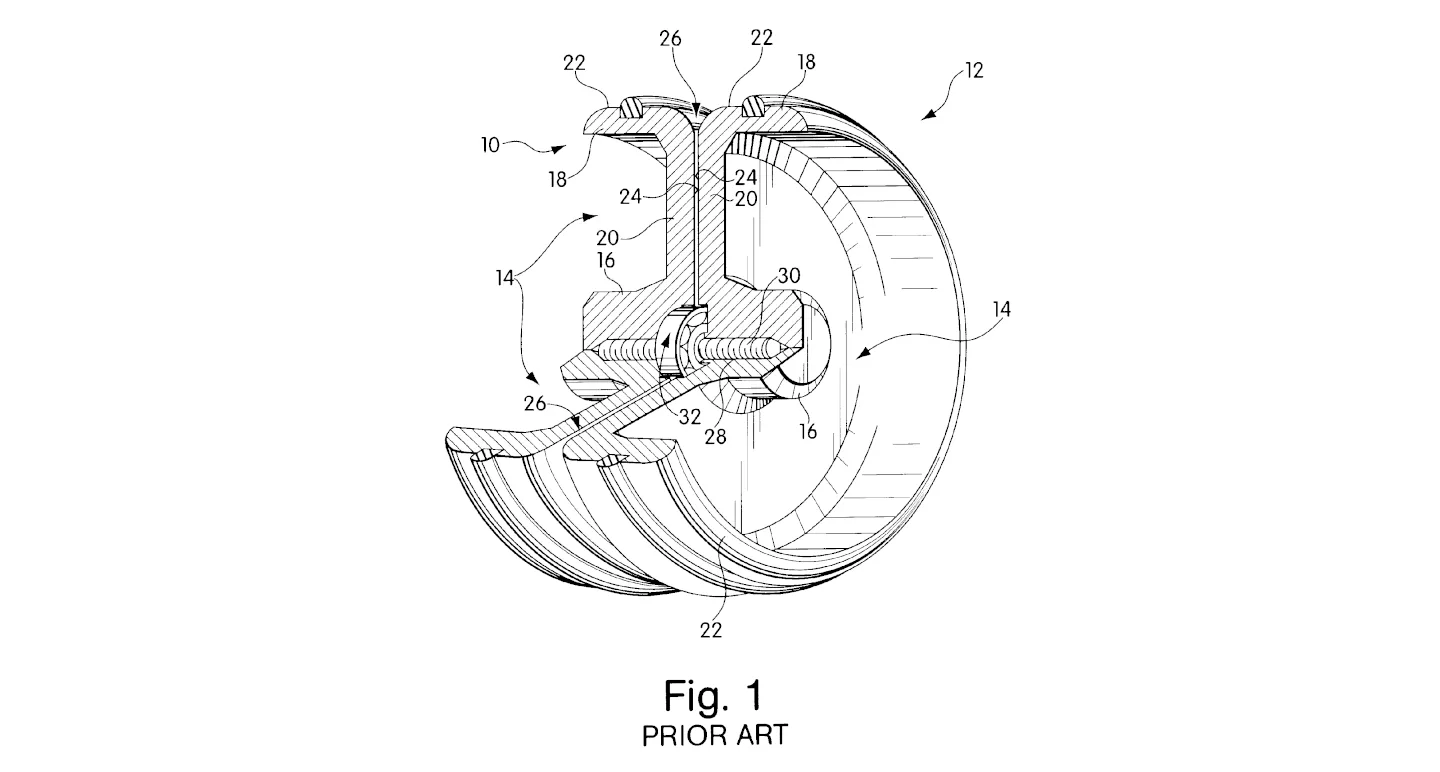
From a Cincinnati whirligig to centrifugal clutches and the courtroom battle that set the name free – the story of who owned the yo-yo, and what that meant for the toy that never stops coming back.
When James L. Haven and Charles Hettrick walked their paperwork into the United States Patent Office in the autumn of 1866, they weren’t thinking about Filipino immigrants, Good Humor ice cream, or federal trademark law. They were thinking about a better way to build a toy that Europe had been calling a bandalore for the better part of a century. They got their patent on November 20, 1866 – U.S. Patent No. 59,745 – and in doing so became the unlikely founding fathers of one of the strangest chapters in American intellectual property history.
This is that chapter.
Before the Patent: The Toy That Already Existed
The honest truth about yo-yo patent history is that patents arrived very late to a party that had been running for a long time. The question of exactly how long depends on who you ask and how generous you want to be with the definition of “yo-yo.”
Archaeological evidence from ancient Greece – terra cotta discs unearthed alongside Greek vases depicting children at play – has led generations of historians to claim the yo-yo as a gift from antiquity. The Strong National Museum of Play cites these finds as evidence of the toy existing as far back as 500 BC. Yo-yo historian Doc Lucky Meisenheimer has pushed back on this interpretation, arguing that 19th-century archaeologist Ludwig Ross made a leap in comparing the ceramic bobbins to bandalores, and that the connection has been repeated so often it calcified into received wisdom. The honest archivist’s position is: possibly ancient Greek, possibly not – the discs exist, the vases exist, the certainty does not.
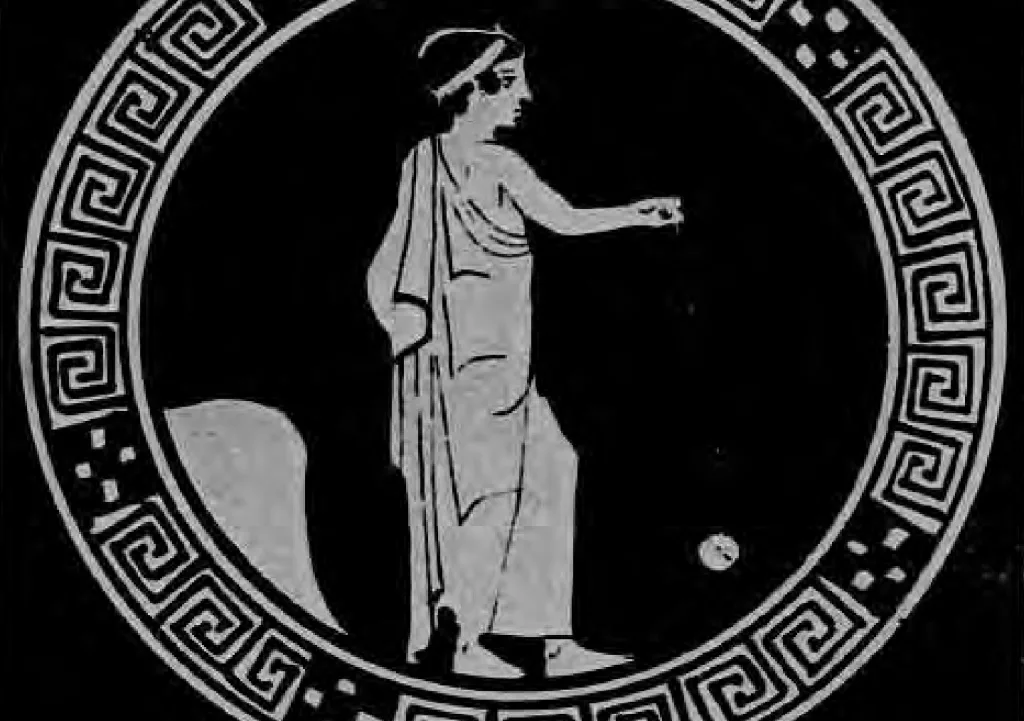
What is well-documented is the toy’s European life in the 18th century. By the 1700s it had reached France, where it picked up a string of glamorous aliases: incroyable, l’émigrette, jou-jou de Normandie. Swedish writer Johan Henric Kellgren mentioned it in a 1791 poem. In England it traveled under the name “bandalore” or, charmingly, “quiz,” and found enthusiastic fans among the aristocracy. By the early 1800s it had crossed the Atlantic – though without the name that would eventually make it a household word.
None of this had anything to do with patents. The toy simply existed, passed from hand to hand and country to country the way folk objects do, without anyone thinking to file paperwork.
That changed in 1866.
U.S. Patent No. 59,745: The Whirligig That Started It All
James L. Haven was a Cincinnati foundry owner. Charles Hettrick (the patent papers render his name variously as Hettrick and Hettrich – even the USPTO couldn’t settle on a spelling) was one of his employees. Together they filed what Guinness World Records recognizes as the earliest known patent for a toy yo-yo, and what they described was not a yo-yo at all: it was an “improved bandalore,” illustrated in their patent diagrams under the label “whirligig.”
The key innovation Haven and Hettrick were protecting was structural. Their design coupled two disc halves “together at their centers by means of a clutch,” using a central rivet – a significant departure from the handmade wooden bandalores of the era and one that opened the door to manufacturing the toy in metal. More importantly for the history of design thinking, it was the first time the concept of rim-weighting appeared in a yo-yo patent. The text reads: “It will be observed that the marginal swell C exercises the function of a flywheel.” The weighted rim as a performance feature, now taken for granted in virtually every modern yo-yo, was being formally described and protected for the first time.
The patent also served as an early proof of concept for using intellectual property law to protect manufacturing improvements in mass-produced toys – a function it would serve many times over in the century to come.
Cincinnati Magazine has noted that the 1929 newspaper coverage of the “new” yo-yo craze managed to ignore this nearly-70-year Cincinnati precedent entirely. Haven and Hettrick built something, patented it, and then largely disappeared from the historical record, their contribution buried under the more colorful stories that followed.
The Patent Surge: 1866–1928
Haven and Hettrick cracked the door open, and in the decades that followed, inventors came flooding through. Tom Van Dan Elzen’s research at the Museum of Yo-Yo History documents a sustained wave of yo-yo and yo-yo-adjacent patents in the late 19th and early 20th centuries:
- 1867: John Syrcher patented improved methods for attaching the string to what he called a “Wheel Toy.”
- 1878: William Katz introduced the “concave” body shape in a patent – an early ancestor of the wing-style profile that would transform competitive play a century later.
- 1867: Charles Kirchhof, a German immigrant working in the United States, patented a yo-yo-type toy he called a “return-wheel,” adding yet another name to the toy’s growing list of aliases.
- 1906: Liebreich & Lothrop’s patent offered a detailed description of rim-weighting, noting that the “outer spherical portion… provides the device with more weight for increasing the efficiency of the operation” – a refinement of Haven and Hettrick’s flywheel observation four decades earlier.
Richard Brough’s exhaustive compilation of U.S. Yo-Yo Utility and Design Patents, archived at the Museum of Yo-Yo History, catalogs this era as one of genuine invention – improvements in materials, construction, string attachment, and balance accumulating steadily even as the toy itself remained commercially marginal. The 1904 St. Louis World’s Fair featured yo-yo souvenirs with significant rim-weighting, suggesting the design improvements being captured in patents were also making their way into manufactured goods.
Then Pedro Flores arrived in Santa Barbara, and everything changed.
Pedro Flores and the Slip-String: The Innovation That Mattered Most
Pedro Edralin Flores was born in Vintar, Ilocos Norte in the Philippines in 1896 and came to the United States in 1915. He briefly studied law, worked odd jobs, and was employed as a bellboy in Santa Barbara when, by his own account, he read an article about a self-made millionaire who had built a fortune selling a ball on a rubber band. Flores knew a better toy than that. He knew the yo-yo.
On June 9, 1928, Flores received a certificate to conduct business as the Yo-Yo Manufacturing Company in Santa Barbara. On June 23, he made twelve yo-yos by hand and started selling them to neighborhood children. By November of that year he had made over 2,000. By early 1929, backed by financiers James and Daniel Stone of Los Angeles, his company was producing over 100,000 yo-yos. A year later, he employed 600 workers across three factories and was producing 300,000 yo-yos daily.
The design difference that made Flores’s yo-yo revolutionary was deceptively simple: the string was looped around the axle rather than knotted to it. This slip-string innovation – now fundamental to all modern yo-yo play – allowed the yo-yo to spin freely at the end of the string, “sleeping” rather than immediately returning. Every trick that depends on a sleeping yo-yo, from the basic Sleeper to the most intricate modern string tricks, flows from that single change.
Here is where yo-yo history requires some careful forensic work. Flores is sometimes described as having patented this innovation. The historical record is more complicated. According to the Yo-Yo Wiki’s documentation on Flores: “Flores had the trademark on the word yo-yo in the US (registered on July 22, 1930), but not as commonly believed a patent on the actual products.” Some Flores yo-yos bore the notation “patent pending” or “patent applied for” – a tactic employed to deter competitors – but no Flores product patent was ever granted. His lasting legal contribution was the trademark, not the patent.
Flores did not claim to have invented the yo-yo. He always maintained that the toy was part of his Filipino childhood, imported into American commerce rather than conjured from nothing. His genuine innovations were entrepreneurial and demonstrative: the slip-string construction, the first yo-yo contests (held in Santa Barbara in 1928, with endurance – keeping a yo-yo going without a miss – as the primary event), and the understanding that people needed to be shown what a yo-yo could do before they would buy one. He hired fellow Filipino yo-yo players as demonstrators, a model that Donald Duncan would borrow, scale, and deploy with devastating commercial effect.
The Duncan Era: Trademarks, Hearst, and the Name That Wasn’t Protected
Donald F. Duncan Sr. was a West Virginia-born entrepreneur who had already built the Good Humor ice cream franchise and would later dominate the parking meter industry. He encountered Flores during a 1928 business trip to California, immediately recognized the yo-yo’s commercial potential, and raised $5,000 to purchase initial rights from Flores. By October 1932, he had secured Flores’s remaining assets – including the trademark on the word “yo-yo” – for a reported $250,000, an extraordinary sum during the Depression.
What Duncan acquired was not a patent. It was a trademark. The distinction would prove catastrophic three decades later.
In the interim, Duncan’s marketing machinery was extraordinary. He partnered with William Randolph Hearst’s newspaper empire – reportedly pitching Hearst directly at his San Simeon mansion after talking his way past a butler – on a promotion that tied yo-yo contest eligibility to newspaper subscription sales. He scaled Flores’s demonstrator model nationally, deploying teams of Filipino yo-yo masters to perform in front of corner stores across the country. He registered additional trademarks: “Genuine Duncan Yo-Yo,” “Butterfly,” and others.
The Smithsonian Institution, which now holds the most comprehensive collection of Duncan materials in existence (acquired from Donald F. Duncan Jr. beginning in 2002), notes that Duncan held the trademark until 1965 and remained the country’s leading yo-yo producer throughout that period. His wooden lathe-turned yo-yos were the standard against which all others were measured. In 1963 – peak Duncan – the company sold 33 million yo-yos in a single year.
But Duncan never held a patent on the yo-yo. The yo-yo trademark was always on shakier legal ground than the company’s market dominance suggested.
Donald F. Duncan, Inc. v. Royal Tops Manufacturing Co.: The Name Goes Generic
The trademark that Duncan had purchased from Flores, defended for three decades, and built an empire upon collapsed in federal court in 1965.
Royal Tops Manufacturing Company challenged Duncan’s trademark registrations for “Yo-Yo,” “Genuine Duncan Yo-Yo,” and “Butterfly.” The case made it to the U.S. Court of Appeals for the Seventh Circuit, which ruled in Donald F. Duncan, Inc. v. Royal Tops Mfg. Co., 343 F.2d 655 (7th Cir. 1965), that Duncan’s trademarks were invalid on two grounds: first, that “yo-yo” was a generic word long used in the Philippine Islands as the name of a certain toy; and second, that through continued usage the word had become descriptive in the United States – a term consumers used to describe any such toy, not a brand identifier for Duncan’s products specifically.
The court’s reasoning drew on a fundamental principle of trademark law: when the public adopts a brand name as the common descriptor for a category of products, the trademark ceases to function as a mark of origin and becomes unprotectable. “Yo-yo” had achieved what trademark attorneys call “genericide” – the same fate that would eventually claim aspirin (originally a Bayer trademark), zipper (once owned by B.F. Goodrich), and escalator (Otis Elevator).
The Yo-Yo Wiki notes that this ruling is now widely considered a miscarriage of justice, and that if treated as controlling precedent it would threaten similarly genericized-but-surviving trademarks like Band-Aid, Q-tips, and Kleenex. There is something to this argument – those trademarks survive today partly because their owners have been aggressive about policing the phrase “a Band-Aid” versus “a bandage” in ways that Duncan, perhaps undone by its own marketing success, was not.
The practical consequence was immediate: Duncan declared bankruptcy on May 28, 1965. In 1968, Flambeau Products Corporation acquired the Duncan name and the company’s assets. The word “yo-yo” now belonged to everyone, and every manufacturer was free to use it.
Richard Brough’s patent compilation notes that 1968 – the year of the Flambeau acquisition – also saw an unusually high number of yo-yo patent filings, suggesting that the collapse of Duncan’s trademark and monopoly position opened the market and prompted renewed investment in differentiated design. When a name can’t be owned, you try harder to own the invention.
The Technological Renaissance: Ball Bearings, Clutches, and the Modern Era
The late 20th century brought a wave of genuine mechanical innovation that generated a corresponding wave of patent activity.
The Transaxle and the Brain (1980)
In 1980, Michael Caffrey patented the mechanism that would eventually become the Yomega Brain: a centrifugal clutch transaxle. The design used a free-spinning plastic sleeve around the axle combined with spring-loaded weights that would pull away from the axle at higher rotational speeds and grab again when speed dropped. The result was an automatic-return yo-yo that came back to the hand without requiring a tug – democratizing yo-yo play for beginners in a way that fixed-axle designs never had. The Brain went to market in the mid-1980s and became one of the best-selling yo-yos in history. Caffrey’s patent has since expired, which is why auto-return mechanisms are now available from Duncan, Abbe Toys, and many others.
Tom Kuhn and the Ball Bearing Revolution (1990)
The most consequential mechanical development in modern yo-yo history came from Tom Kuhn, a San Francisco dentist with an obsession for precision-machined wooden yo-yos. In 1990, Kuhn released the SB-2 (Silver Bullet 2), a yo-yo machined from aircraft aluminum with a ball bearing axle and an adjustable gap. Swedish bearing company SKF had briefly experimented with ball-bearing yo-yos in the 1970s, but Kuhn’s SB-2 was, in the assessment of the community, the first ball-bearing yo-yo that actually worked – delivering dramatically extended spin times and reliable return. Kuhn received the inaugural Donald F. Duncan Family Award for Industry Excellence in 1998 and is widely referred to as the “Father of the Modern Yo-Yo.” His ball-bearing innovations, while not always individually patented in the same sense as a manufacturing patent, fundamentally reshaped what competitive yo-yo play could look like.
Yomega’s Continued Patent Activity
Yomega – founded in Fall River, Massachusetts – became one of the most patent-active companies in the toy industry through the 1990s and early 2000s. The Brough patent compilation documents a sustained series of Yomega filings covering variations on the transaxle system, ball-bearing configurations, and related mechanisms. A 1999 Yomega patent filing for a ball-bearing-enhanced yo-yo cited Haven and Hettrick’s 1866 whirligig patent as prior art – a remarkable 133-year chain connecting a Cincinnati foundry owner’s “marginal swell” to a Rhode Island toy company’s precision engineering.
Yomega’s 2003 patents – including U.S. Patent No. 6,565,408 for a “high performance roller bearing yo-yo” assigned to Yomega Corp. – represent the high-water mark of the company’s patent-driven competitive strategy during the late 1990s–early 2000s yo-yo boom.
The Modular Era
The early 2000s also saw patent filings for modular yo-yo designs. U.S. Patent No. 6,579,142, filed in 2003 by Rehkemper and Hannon and assigned to Rehco, LLC of Chicago, covered a “modular yo-yo” – a take-apart design anticipating the now-universal expectation that a quality yo-yo should allow the player to adjust its response, replace its bearing, and change its pads. The modularity that contemporary players take for granted was, briefly, a protected innovation.
What Patents Actually Protect (and What They Don’t)
One of the recurring confusions in yo-yo history – visible in everything from Wikipedia articles to collector forum posts – is the conflation of patents, trademarks, and copyright. The Haven/Hettrick story and the Duncan saga together offer an unusually clean tutorial in the difference.
A patent protects a specific mechanical innovation for a limited period (20 years under current U.S. law). Haven and Hettrick’s patent protected their rivet-joined, rim-weighted disc construction. Caffrey’s patent protected the centrifugal clutch mechanism. When these patents expire, as they all eventually do, the protected innovations enter the public domain and anyone can use them.
A trademark protects a name or mark as an identifier of commercial origin. Flores registered “Flores Yo-Yo” in 1930. Duncan acquired it and registered “Yo-Yo,” “Genuine Duncan Yo-Yo,” and “Butterfly.” Trademarks can theoretically last forever – but only if they continue to function as identifiers of origin rather than generic product names. The moment a trademark becomes the way consumers describe a product category rather than a brand, it can be challenged and canceled.
Neither patent nor trademark protects the design – the specific aesthetic appearance of a yo-yo body – unless a separate design patent is filed. Design patents appear throughout the Brough compilation and protect things like the distinctive shape of a particular yo-yo profile, the arrangement of decorative elements, or a specific cap design.
The practical result of all this, for the contemporary market, is a patent landscape that has been largely cleared by expiration. Caffrey’s clutch patent is expired. The foundational ball-bearing patents are expired. The rim-weighting innovations documented from 1866 through 1906 are, obviously, long expired. What remains protectable through patent is genuinely new mechanical innovation – responsive systems, bearing retention mechanisms, new materials applications – and through trademark, distinctive brand identifiers that are actively policed to prevent genericization.
The Archive Perspective: What Patents Tell Us
Patent filings are, among other things, historical documents. They record not just innovations but anxieties – the specific fears that someone will copy what you have built. Haven and Hettrick patented their whirligig because they were, as Tom Van Dan Elzen has argued, probably already mass-producing the toy and wanted protection for that investment. Flores used “patent pending” strategically, as a competitive deterrent, even without the underlying patent to back it up. Duncan spent thousands fighting to keep “yo-yo” as a trademark in a battle that, in retrospect, was probably unwinnable once the word entered the common vocabulary.
The modern independent yo-yo market – the world of One Drop, G2, CLYW, MK1, Dressel Designs, and the dozens of other small manufacturers who define contemporary yo-yo culture – largely operates outside the patent system. The fundamental innovations are expired or have been designed around. What these manufacturers protect is brand identity, aesthetic language, and the trust of a community that has learned to distinguish their work by feel and reputation rather than by legal exclusivity.
That’s arguably a healthier ecosystem than one built on IP moats. But it took 160 years of patents, trademarks, lawsuits, and one very consequential bankruptcy to get here.
The string is still looped, not knotted. Pedro Flores figured that out in 1928. No one has successfully patented a better idea since.
Sources and Further Reading
- U.S. Patent No. 59,745 – Haven & Hettrick, “Bandelore / Whirligig” (1866), available via USPTO.gov
- Brough, Richard. U.S. Yo-Yo Utility and Design Patents, 1866–Present. Museum of Yo-Yo History / yoyomuseum.com
- Shayt, David. “Yo-Yo Ups and Downs.” Smithsonian Institution / Lemelson Center for the Study of Invention and Innovation, 2003. invention.si.edu
- Smithsonian Institution. “Yo-Yo History in America.” si.edu/spotlight/yo-yo
- Smithsonian Institution. “Duncan Genuine Yo-Yo.” si.edu/newsdesk/snapshot/duncan-genuine-yo-yo
- Strong National Museum of Play. “Out of This World: A Brief History of the Yo-Yo.” museumofplay.org
- Tom Van Dan Elzen. “History of the Yo-Yo.” Museum of Yo-Yo History, theyoyomuseum.com
- Yo-Yo Wiki / Fandom. “History of the Yo-Yo”; “Flores”; “Donald F. Duncan”; “Yomega Brain.” yoyo.fandom.com
- Donald F. Duncan, Inc. v. Royal Tops Mfg. Co., 343 F.2d 655 (7th Cir. 1965)
- Guinness World Records. “Earliest Patent for a Yo-Yo.” guinnessworldrecords.com
- Cincinnati Magazine. “The Yo-Yo (or Whirligig, or Bandalore) Had Quite a Spin Through Cincinnati History.” cincinnatimagazine.com
- Edison Nation Blog. “Learning from Donald Duncan,” 2018. blog.edisonnation.com
Have a correction, an addition, or a scan of an obscure yo-yo patent we haven’t seen? The Archive is always collecting. Find us on Instagram @theyoyoarchive or reach out through the site.