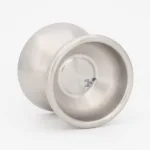
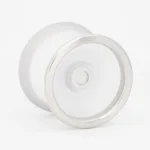
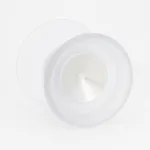
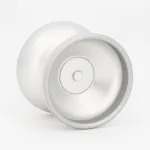
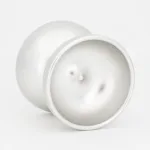
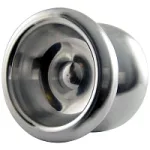
We’re proud to introduce our newest entry – a bobbing, popping, bundle of fun.
Say hello to the Fruitloop!
SPECS
dia 53.7mm
wid 47mm
weight 65.2g
material 6061 AL
The Fruitloop began with the desire to return to levity in throwing, and that process has resulted in the most fun design we’ve made to date.
Much of 2021 had been spent working on more technically challenging and performance-oriented designs. After months of poring over a thousand CAD revisions, we felt the need to disrupt our rhythm slightly, and just do something playful.
our aim from the beginning was to depart from the traditional organic form and design a rounded, ball-like model that would whizz, whip, run and roll through tricks. In other words, sacrilegiously unoptimised for the modern trickset, but something you couldn’t bear to leave home without.
Initial drafts of the first prototype were made under the working title, “Pebble”, conveying the sense of a small, compact, ball-ish object. It captured the essence of what it should feel like in hand; we also wanted it to feel more solid than what is usual of our organic lineup.
Our first prototype came back after some tinkering, and featured a thick 49mm width, 53.7mm diameter profile, with a majority of its mass packed in the hub. The mass bias was evened out by a ring-shaped machined aluminum cap, which was press-fit into the main body.
Having worked on the CAD, we knew how it would look, but having the physical prototype in hand for the first time – its unique profile reminiscent of a certain breakfast cereal – felt simultaneously amusing and inspiring.
Yoyo-ing can be self-serious at times. Holding an aluminium doughnut can be a good reminder that the ultimate substance of our hobby is having joy in play.
The first prototype was very interesting in motion. It was endlessly floaty, veered off-axis too easily, and required more constant application of movement and force than other designs we’ve made. At the same time, I felt myself gravitating towards hops, rolls, funky binds and odd whip-regens – the satisfying, frivolous stuff that are unapologetically my guilty pleasure.
Coleman, who tested and provided feedback for the prototype, mentioned he found it nimble and agile, ran faster than he expected, and floated with all the buttery smoothness anyone could want. He also enjoyed the effect of the Fruitloop rounding-off quick movements – a dampening that made movements feel gradual and natural that I experienced, too.
The prototype was promising – Evgeniy found it pure fun, but surprisingly capable for a “fun yoyo”, and gravitated to both its form and play – but we wanted to make a few tweaks .
The overarching sense was that the prototype had to be consolidated. It was a bit too wide (even by our standards), and played just a bit too airily – perhaps an unexpected criticism for such a concept – but the team agreed moving towards compactness and density felt right.
The second version (left, in lighter pink) came back perfectly aligned with our initial vision of how it should play and feel.
In probably a first for an Atmos design, we slimmed the overall profile – by just a bit. We also made the Schmoove-step less aggressive.
The most significant tweaks were made to the overall distribution of mass, primarily through the modification of the ring-caps. We increased its mass by roughly 10%, and altered its construction for a more secure fit with the rest of the body.
The new, slimmer and weight-adjusted Fruitloop retains the movement signature of the original prototype, which I think lends itself to redirects, and more rhythmic play. Additionally, it spins much better, has a cleaner gap width, and the unique dampening and rounding effect feels nicely paired with its new, fuller construction.
We’re usually conservative with releasing colorways, as we prefer to maintain a cohesive palette with each release.
The Fruitloop presents a unique (and wholly positive) challenge on this front, given its namesake cereal is characterized by what feels like a spectacle of colors.
As research (and breakfast) goes, I bought a box of the good stuff to dissect, and with some surprise figured there are, in truth, only six Frootloop colors – red, orange, yellow, green, blue and purple. I was considerably deflated, having operated under the grand illusion this number was something closer to 78.
We decided on a palette of eight to round off the set, and we’re in love with how they came out.
Short aside: this is not something we’re officially recommending, since it is vaguely equivalent to ripping rings out from bimetal designs, and may cause vibe, but – they do this.
For the more experimental and less precious amongst us – a colorway extravaganza awaits you.
The Fruitloop is not made for tech (although Evgeniy still finds a way to do elegantly complex things with it). It’s certainly not the yoyo to pick up if you’re into speed play or the latest competition meta. It’s actually even structurally biased against finger spins and DNA binds, and it won’t break any long sleeper world records. If you’re looking for a powerful performance beast, we genuinely recommend you to set your sights on other industry offerings.
However, if you’re like us – in need of something a bit different – perhaps in the search of a fun, boppy and rhythmic throw that will bring on hours of jamming fun, something unique to freshen your rotation, or something playful that might inspire the next shoot-the-moon-behind-the-neck-regen banger that will set the collective interwebs on fire, the Fruitloop might just be for you.
Note: Fruitloops come with a deep blast that feels similar to the one applied on the Noahs, but is smoother, and less aggressive. It gives the Fruitloop a lovely matte, clay-like finish.
We’ve tested the blast for string breakage risk with approximately 120 mins of play on a single string that is thinner than the average “fat” bulk spec with no resulting breakage issues.
However, we recognize some variance exists; should your string show premature wear, we recommend taking some time to lighten the blast on areas that make the most contact with your strings. You can do this by rubbing the inner walls with old denim or a leather belt to alleviate any abrasiveness. We recommend doing this for a few minutes, and it should be perfect for play after a good buffing.
We’re incredibly thrilled to bring you the latest instalment in our featherweight organics design line.
Meet Abel.
SPECS
Dia 54.3mm Width 48.4mm Weight 63.2g Material 6061 AL
The Abel is easy to introduce.
Its antecedent, the Noah, began as a project in making an unapologetically light and round, blank-canvas organic that leaned fully into characteristics of the form factor. It had no bias for rim weight, a bubbly-wide and comfortable frame, and an incredibly fun lightness.
The Noah took off in ways we didn’t imagine, and became one of our own favourites.
The Abel extends that project of making our version of a fundamental, purist’s organic, and takes another step towards simplicity.
It has endless curves, and lines only where strictly necessary.
The most obvious difference is that the Abel isn’t compatible with Side Effects, a design feature that is core to the Noah.
It’s not really addition via subtraction here; the Abel isn’t intended as an upgrade over the Noah. It’s more of a 1a) and 1b) sort of deal.
Some players deeply enjoy customisation and control over the way a yoyo plays; some others enjoy the ease and intuitiveness of playing it as they come, and find tuning an additional effort.
The Noah is for the tinkerer; the Abel is for the player who doesn’t need to fiddle.
On that note, the Abel is one of the smoothest designs we’ve manufactured. This thing is just glass.
The Abel is machined out of 6061 aluminum bar stock, a switch from the 7068 alloy that the Noahs used.
We apportioned some of the extra material along the cup to give it an even, if slightly center-biased distribution.
We also added a tiny nub in the center of the cup – a homage to Flat Caps and the original Side Effects compatibility of its forebear – that many observed.
We enjoyed its subtle disruption of the otherwise unbroken curvature of the hub. It’s similar to the little “halo” groove that marked our initial line of organics, beginning with the Cloudberry and most recently in the Goji – an understated, light touch that we enjoy.
This nub is also featured on a few designs we have in the oven, and we can’t wait to show you more in due time.
The Abel clocks in at 63.2g, which is less than a gram heftier than the Noah in its lightest configuration.
The Abel’s weight distribution sits between a Noah with AL Ultra Lights installed, and another fitted with AL Flat Caps. It plays that way, too. It’s got a bit more body and presence than a Noah at its most featherweight form, but retains every bit of its light touch.
The Noah was originally designed as a miniaturised blend of the Goji and Pomelo (anyone who has played these two would understand this comparison), and the Abel shares that lineage. It’s endlessly boppable, light, and 63.2g of relaxed fun in a midsized frame.
The name Noah refers to a sense of restfulness and calm that we hoped to capture in its design and play. Abel translates to breath and vapor – a fitting name, we think, that encapsulates a sense of airiness and tranquility.
The Abel comes with a matte, ceramic-like blast that allows the colors on these to pop.
We masked the inmost portion along the schmoove step to keep it entirely unblasted and smooth, so as to reduce friction between the string and the matte surface. We also hand-process each Abel with various fabrics to further mute surface friction.
A handful of Abel prototypes were sent out to a list of friends and supporters of Atmos earlier in the year, as a way of expressing our gratitude for the incredible support we’ve received, and also to ask for feedback on the Abel. It was a wonderful exercise in testing on a scale we had never done before.
The Abel is the Noah’s slightly reserved but self-assured twin brother.
Smooth, airy, and easy, and it does everything with a light touch.
We’re proud to introduce the Snowberry – it’s plastic fantastic.
SPECS
Dia 56.4mm Width 50.5mm Weight 65.6g Material Delrin
Most of our design journals pay a degree of homage to the lineage that precedes it, but a look back in history never made more sense than for the Snowberry. At risk of sentimentality, the significance of our first plastic design lies in the very roots of what we now do at Atmos Projects.
I came into the scene around 2006, a time where design sensibilities were starkly different from what they are now. I was always taken by the design leaders of the era, such as Caribou Lodge, One Drop, and Yoyofactory, but I got started on a steady diet of ball-bearinged plastics – I began throwing in high school with a Duncan Throw Monkey, moved on shortly to the Freehand Zero, and then eventually throws from other brands such as the now-defunct, but eternally amazing Yoyojam. The Patriot, Journey and Lyn Fury featured regularly in my rotations. Another fun fact was that I mainly played 5A for years before I transitioned to 1A, deciding it was what the cool kids did – but my taste for wide and round shapes that were suited for 5A play was forged in those years.
These plastics were perfect for the time. They could take the hits that came with perfecting counterweight tricks, and you didn’t ever have to feel precious with them. And they played so satisfyingly.
In 2007, Paul Yath released the Milk under his brand, Crucial. I never got to own one myself, but took every chance to play with one that belonged to a friend. It shifted my perception of plastics considerably; the machined delrin felt like an altogether different material from injection molded polycarbonate – softer, denser, more refined, and incredibly smooth to the touch. Years later, the One Drop Cabal was released, and again, I was fascinated by what I imagined was a Delrin reincarnation of the Markmont Classic. This time I managed to get my hands on one.
Sometime last year I doubled down on this Delrin exploration, and managed to acquire a Crucial Cream and Yoyopalace (now Sense) Sphere. In my book they are such joyful designs that are severely underrated.
All that to say – there’s an enormous nostalgic significance that sets the context for our first plastic design.
Sometime in 2021, I started toying with the idea of making a delrin yoyo. The reasons for not doing that as a small boutique gig like ourselves are myriad and endless. But I was keen to try, even if it meant the project ended with a couple of prototypes of a design that didn’t make sense for a larger production.
I began with the Cloudberry’s shape as a reference; this was the most instinctive starting point, given its big, round shape that isn’t identical to but reminiscent of the Milk and the Patriot. It was also a natural progression of our exploration of materials in the Berry line – two monometals (in the Cloudberry and Thunderberry), then bimetal (in the Stormberry), and now a fully delrin iteration. It features very similar features, such as the schmoove-step.
The diameter was kept to 56.4mm, which is consistent throughout the Berries, but we increased the width to 50mm. The idea was to keep the weight distribution similar to the Berry series, and the playfeel in the same zippy, floaty and light-stable range.
One thing we were insistent on was maintaining a fully plastic exterior. Modern machined plastic designs generally have an exposed metal insert in the hub, which are at times adapted to aid tricks like finger spinning. But what was entirely arresting about the Crucial Milk was its pure white structure. ditto with the cream and the sphere. We felt a metal nub in the hub would be a distraction, a visual disruption to an otherwise full and uninterrupted surface.
In later prototypes, we configured the spacer inserts to sit embedded within the delrin hub, and then be concealed by a small machined delrin cap, which features the “halo” groove signature to the Fruitbowl series. We worked with our machinist to experiment with multiple spacer constructions, and finally settled on one.
(L-R; early prototypes to final production version)
Initial prototypes came in, which made for a very exciting day. Prototype I was a wobblefest. Prototype II had a small, unobtrusive metal nub; it played more solid and was slightly smoother on string; Prototype III was full-delrin, was degrees floatier and lighter, but had a bit of vibe. I sent Prototype II and III to Coleman and Evgeniy. I preferred Prototype III, but wanted to triangulate my own thoughts with their feedback. After some play, their responses leaned towards the fully-delrin version. Evgeniy referred to it as the “monolith proto”, which I thought was cool, and mentally I referred to it as that from then on.
Coleman put the Snowberry through its paces in his own singular way, with flowy, relaxed combos that feel more like an art form than anything.
To fix the slight vibe, we adjusted the hub and spacer construction again for tighter and more secure fit against the delrin body, and they came out playing great. The production version also has a bit more weight – plastic designs have a tiny bit of variance weight-wise, but the Snowberry sits around 65.6g.
It’s very slick on the string, and has the classic Atmos lightness of feel. it has the same fluffy-oomph of the Cloudberry, but is even softer.
It’s an unapologetically wide and fatty organic, it’s very stable for a plastic, and spins long enough for a modern trickset. It won’t beat a new bimetal at sleep length if you’re counting seconds, but if you’re genuinely thinking about trick capability – have you seen what Evgeniy has done with it?
The modern market can feel like an arms race sometimes. This is a wholly positive thing – variety and availability of quality designs are great, and it’s never been a better time to be a player. Saturation generally breeds innovation and creativity.
In a crowded space, the ones I’ve personally found inspiring have a quietly oddball quality to them; the CLYW Arctic Circle 2, the A-RT 420, a-rt x sf dk, and the RSO Spaceship ES sit amongst our favorites; and amongst those we produce, the Noah, Abel, Fruitloop and Goji. It’s not a stretch to say all these designs are an imperfect fit for the median player who looks for least error, but in play they just make me go, oh.
The Snowberry sits in that pocket for us; it recaptures feelings of uniqueness and nostalgia, and also an excitement of old.
The Snowberry is a plastic yoyo — it’s plastic fantastic. It’s a thank-you note to its plastic forebears that kickstarted many yoyo journeys. It spins incredibly well, it feels slick and smooth on the string. It can take a tumble, it’s soft in the hand, it’s the one you chuck in your bagpack and bring on a hike, it’s the one you pull out to teach your younger cousin how to yoyo. it’s one for all seasons.
It feels familiar, like throwing snowballs in January.
Dia 57mm Width 46mm Weight 68.1g Material titanium
Shortly after the release of the Ari in February 2022, we began dreaming up concepts that would be fitting for an Ari Pro. This began early with talks with Evgeniy getting his Ari – incidentally his first Atmos design – he loved the feel, the width, and the light but powerful play of the Ari, but also mentioned he desired a bit more mass. We started sketching up a few concepts, and had a few in queue while we focused our developmental attentions to other projects in our pipeline, such as the Abel and Snowberry.
We returned to the concept shortly after, armed with feedback from Ari users. The Ari is and has always been a tinkerer’s model; it has a very light base weight, and was designed to accept One Drop Side Effects, Freehand-sized caps, and even rubber o-rings, which allowed a user to construct his own build, up to north of 70g. The only drawback with adding more moving parts on a precision design was that tuning became a necessity.
In our view, tuning isn’t something to be avoided – its a useful skill in yoyoing, similar to being able to correct string tension. It’s easy, and frees one up to enjoy SE-enabled yoyos without unnecessary frustration.
But the larger point for those who had played the Ari was that there was desire for a version unencumbered by the need to customize, assemble, and calibrate. There were calls for a high performing design in the format of the Ari, but even further simplified. Players loved the Ari’s physique, the full-frame form factor, and our use of titanium; but they were requesting play-readiness, and a sharper focus on high performance. That felt aligned to the Pro designation we were thinking about for the next iteration of the Ari form factor.
This brought us back to our conversations with Evegeniy about weight, and after some back and forth, we decided to move into the realm of heavier concepts.
We’ve generally kept our designs below 65g. One design that has broken that soft rule is the Snowberry, oddly enough our heaviest design to date, which clocks in at 65.6g. We’ve mostly been able to do creative things with width and weight distribution in achieving light power without piling on the pounds – case in point, the Snowberry, which is also arguably our fluffiest design in our lineup. For our design purposes the 62-64g space mostly suits us well.
But with this overt dip into heavyweight territory, what we were hoping to achieve in playfeel was akin to the handling and feel of performance cars with low ground clearing – that of torque, gravitas, balance, and the ability to turn tight corners at speed with supreme handling and full, fine control.
68g can sound extreme to some, given there are 66g designs that play sluggishly. The playfeel that players dread is the thudding rock on the end of a string that resists all types of movement. With the Aria, the idea was to design something with considerable mass but distribute it well enough across the Ari’s large 57mm and 48mm frame, so that it would feel substantial and balanced, but not unwieldy and reluctant.
This was one of the earlier prototypes we made of the Aria, machined on aluminum stock for feasibility testing – it had a stepped hub and an even more pronounced nub. We made multiple early prototypes, but they were all condemned by vibe and never made it past testing phases; the weight distribution was too extreme.
Eventually we simplified the wall design, and reduced the overall width from 48mm to 46mm – which, interestingly, makes the Aria our narrowest design to date.
The Aria also has significantly thicker rims than the Ari, giving it a lot more power. Crucially, we graduated the mass bias from the center to the outer rims, which gives the Aria a powerful, but very smooth acceleration and handle.
The Aria is deceptively deft and nimble for a 68g yoyo; it has that low-center-of-gravity smoothness, superb control and pace, and a powerful stability. It’s difficult to throw it off kilter. It stops on a dime. Once it gets moving, it plays lighter than 68g might suggest it would, and has all the spin you need – and then some more, and then some more… and then some more.
It’s everything we were hoping to achieve in an Ari Pro.
The Aria comes equipped with premier kit in Black Stratos Pads, Atmos Type I Concave Bearings, and Zipline Strings’ Case Study #50s.
After months of teasing, we’re thrilled to finally present the Cephas.
SPECS
Dia 54.3mm Width 48.4mm Weight 65.2g Material 6061 AL
In case you’ve missed it, we wrote a bit about our Design Lines as of 2023 — in short, they represent different design pursuits in what we do here at Atmos Projects.
To that point, the Cephas is the newest installment to the Classic O’s line, which collectively focuses on minimalist organics, and is the latest iteration of the Noah and Abel.
Most immediately, the Cephas takes inspiration from forebears that share its flat capped visage. The foremost of the group is likely the SPYY Pure, which was released in 2009; the genre is also populated by others such as the Turning Point Bacchus, Core Co. Diesis, and most recently, the Duncan Freebird 3. The SPYY Pure in particular holds sway in the conversation for its unique manufacturing processes. As far as we know, the hub and the cap were separately machined, assembled, and then further machined on the lathe to render the already microscopic gap between the individual pieces invisible. This gave the Pure — very aptly named, we think — an iconic uninterrupted, solid-piece look.
The designs of the Bacchus, Diesis and Freebird 3, on the other hand, emphasize the point of assembly, rather than hide it. The “rims”, which encroach on the main body, somewhat resemble the Yoyojam-era of hybrids, or even how modern outer-rim bimetal rims look like.
Our intent with the Cephas was to recreate this former sense of purity and minimalism within our organic form factor.
In the prior designs mentioned, none featured a strictly organic silhouette – their inner walls feature straight lines extending towards the rims, even if the outer hubs eventually rounded off. Where the flat caps provided a simple, austere look, the side profiles were slightly busier, with harder lines and faux rims.
We were compelled by the notion of an extremely round, organic model combined with the simplicity of a flat cap feature, with no visual hints at joinery, or discontinuation between body and rims – the Cephas thus builds on the Noah and Abel’s physique, which features clean lines and round, uninterrupted curves, and the integration of its capped design gives it a monolithic, solid feel.
But beyond mere visual difference, a thicker, more powerful, hollowed-body version of the Noah and Abel was, to us, an interesting marriage of different design concepts.
The cap conceals the hub, the primary site where we overhauled the base weight distributions of previous designs. To begin, we carved out mass from the center portion of the hub, giving it a cavernous hollowed-out body, and also to allow for a disproportionate concentration of mass closer to the rims.
The Cephas weighs in at 65.2g, which is the heaviest of the Classic O’s line — the Abel clocks only 63.2g, and the Noah an even lighter 62.3g. A majority of this additional mass lies in the caps, which actually weigh 8g each — that’s about a quarter of its overall weight in the caps alone.
The effect of this adjustment is obvious – where there was nearly zero bias towards rim weight in the Noah and the Abel, this new weight distribution makes the Cephas the longest spinning and most stable installment of the Classic O’s.
This is assisted by a familiar schmoove-groove, which is less pronounced than those in the Fruitbowl Line. We made minor tweaks in the Cephas’ schmoove-groove for an even smoother play experience.
It still feels bubbly and extremely comfortable in hand, and features a familiar relaxed, agile playfeel, but it also has a steadier, more even presence compared to its two brothers.
The Cephas sits in a lineup of featherweight organics characterized by light, floaty playfeel – and it distinguishes itself in that company by its solid, grounded presence.
To that end, the name Cephas – etymologically connected to “Peter”, both of them loosely translating to “rock” – playfully overstates that relative heft. Where “Noah” gestured towards “rest”, and “Abel” towards “breath”, the name Cephas is a reference to its relative stability and solidity.
For those more literally inclined, don’t fret – it doesn’t actually play like a stone on the end of a string.
The Cephas joins the Classic O’s as a perfect everyday throw, best suited for relaxed, flowing play, and provides enough power and stability for uncompromised hours of pure fun.