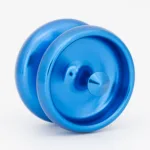
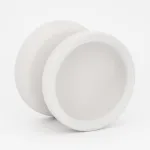
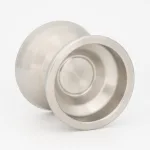
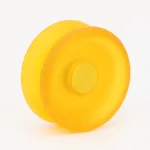
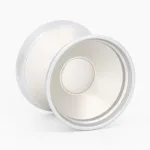
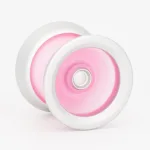
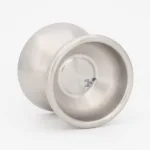
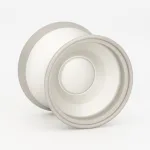
Goji

The following is archived from Atmos’ website:


This has been a crazy month for us, having just released the Gravity with Round Spinning Objects. That was a whirlwind, and we’re incredibly grateful for all of your support.

All the same, we’re very excited and proud to announce something that has been in the works for a long time.

Say hello to the Goji.

SPECS

dia 52.5mm
wid 49.7mm
weight 63.5g
material 7068 AL

If you’ve been on this thread at all, you’d know that our design process always begins with some acknowledgement of history. That is usually where we begin, and our hope is that by the end of each design cycle we have added on to the body of work that has come before.

The Cloudberry was our attempt to saddle lightness and power and to find its place a long line of great organics; the Pomelo an oversized featherweight that pays homage to the fat, chunky designs of the 2000-2010s era.

The Goji begins with the lineage of great undersized organics. It is easy to call to mind which they are, because they’ve been and remained iconic throughout the years – Yoyofactory’s 888, Caribou Lodge’s Wooly Marmot, and Anti-Yo’s Bapezilla remain some of the most emblematic and enduring instances, and in my view, this lineage is continued today in wonderful designs in One Drop and Static Co.’s Parlay and Sudo, and A-RT’s Sparrow, amongst a few others.

The challenges for us in putting out something we felt could stand amongst such storied designs were in adapting the classical shape and specifications for modern play. Undersized designs are sometimes limited in spin power and stability. That “sensitivity” to off-axis movement is part of the joy that accompanies small and round return tops.

At the same time, we wanted the experience of someone using the Goji to be as thoughtless, free, and unexacting on the player as possible – something you could just comfortably jam with, without it requiring too much care and focus.

We wanted to take the intensity and intentionality of honing a player’s precision out of the experience, and provide something more fun, more effortless.

Our first prototype weighed in at 66.6g. It was a total spin machine.

Isaac Sams is someone we’ve had the privilege of helping us test early iterations of our designs. Of the Cloudberry, Thunderberry, Pomelo and the Goji, he wrote back saying the Goji was his favourite – that was quite an affirming moment for us.

Still, I personally felt it overpowered the Thunderberry, which was an interesting and exciting experience in itself – it could just go on and on. It reminded me of the Bapezilla 2, which felt thunderous in playfeel despite having an unassuming profile.

Power wasn’t an issue, but its nimbleness was.

An early design prompt that was core to the process of creating the Goji was that it had to feel like it could “run” on the string.

An early working title for the project before we settled on a final name was Peter Rabbit, which was meant to help us visualise the sort of liveliness it should have in play. If you’ve ever seen old videos of Jensen Kimmitt trick-shredding on a Wooly Marmot in that inimitable hop-style, you’d have a sense of what we were fixated on.

We took a month off design work to play and test the Goji, so we could find clarity in what we wanted to keep, and what we’d take off the board.

We liked the Goji’s profile, and so we retained its silhouette completely intact, but we eventually overhauled its entire weight distribution. After reconstructing its rim and cup, the design turned out 3.1g lighter, which is a significant mass for any return top, much less one this small.

Prototype II came back possessing that very litheness on the string. It isn’t as powerful as Prototype I, but still has enough juice to get through most modern tricksets.

It’s not meant for competition in the slightest, but if kicking back and jamming for hours is something that sounds like a good idea to you, you might just like the Goji.

This thing just sprints across string.

d4d276604841b88a79b15111f99655c641ecee7c_2_690x460.jpeg

As always, thank you for getting to the end of another of these very long posts. If you have any thoughts or comments, I’d absolutely love to hear what you think!

·

Khuno

The following is archived from Atmos’ website:


We released the Cloudberry, our first model ever, exactly year ago in September 2020. The original concept for the Fruitbowl Line, which the Cloudberry kickstarted, was to us something of a design study in the organic genre and what play experiences they would yield based on dimensional tweaks.

For our sophomore year, we’ve been looking to take a little bit of a different direction. A Season II of sorts. We’re still going to be working on organic designs, whether released under the Fruitbowl Line or not, but Year Two will feature us pursuing a distinct design angle under our Weatherman Line.

As the debut design of this line, we’re very proud to introduce the Khuno.

SPECS

dia 57.0mm
wid 48.3mm
base weight with AL Ultra Lights 63.5g(maximum stock weight of 71.7g)
material 7068 AL · SS
includes AL Ultra Light SEs, Brass Ultra Light SEs, and blank Duncan caps

This is the first non-organic we’ve released. W shapes have been a space we’ve been interested in a long time. Personally, I find them a bit more intriguing than the pure V-profiles that generally occupy the competitive, performance-oriented space. Part of this is due to my experience with incredibly made W-shape throws – some of the best instances of these throws, in my opinion, are made by the elder statesmen of the return top design game. Zach Gormley’s Arctic Circle line and Mark Mangarin’s Akita by CLYW, the Kuntosh by One Drop, and the Summit by the two companies top my private list. One Drop’s Sugar Glider is also a sleeper winner that I feel is confusingly underrated.

These Ws offer the performance edges of a more competitive profile, but retain the comfort and feel of rounder shapes.

This was our first prototype of the Khuno.

The base concept we began with was that of a customisable, competitive W-shaped return top. The foundation of this concept centers on the view that player preferences on competitive features are not so monolithic, and that variability – a feature usually reserved for more casual designs – is favourable even in the performance space.

Having sufficient power is a given, but there is less of a consensus when it comes to weight and feel. One might perceive the general narrative to favour the floatier and lighter of designs, but there is fair presence of those who prefer a heftier ride.

I got to know Thawhir Iqbal, Singapore’s and Asia’s 3A champion, when I was working on the Gravity project, and his feedback on my designs and early prototypes have been illuminating.

The first time we met, he opted for the heavier of the few Gravities I brought to the shoot, and at a later session commented he felt the Khuno prototype (then outfitted with Aluminium Ultra Lights) was too light.

His preference is for throws in the 67g-69g range; he feels that the extra weight compensates for stage nerves. His experience has been that when a player is nervous, his jitters can make everything feel lighter, flimsier, harder to control.

Light and agile can be enjoyable in a casual setting, but the additional mass can be anchoring, grounding, when a player is competing on stage. He gestured towards the Turning Point Mustang ES as reference, his choice for competitions, which comes in at 68.7g.

The moonshot for us was to create a Side Effects-compatible bimetal, which would ideally combine high performance with the freedom to switch things up. The hope with the Khuno is that wherever your play preferences lie on that spectrum, its customisability gives you control to dictate your preferred feel on the string.

(Prototype I on left, Prototype II on right)

The initial prototype came back playing great, but had a few setbacks we had to address.

At its lightest setup, it was agile and had a nice floaty signature. At the same time, it lacked the aggressive power we felt necessary for a performance-focused concept. The curved ridge that bridges the inner wall and outer rims also made it slightly sharp on the catch.

For Prototype II, we added a touch of rim weight in the stainless steel rings, tweaked the mid weight in the aluminium body, filled out the curved ridge into a graduated slope, and rounded some edges. The new profile feels significantly better in the hand and has a nice, full presence on its spin.

One challenge of creating a Side Effects-compatible bimetal is in allowing for a meaningful range of weight while preserving sufficient mass in its stainless steel rims.

In other words, its lightest and heaviest configurations have to be actual playable weights. If the lightest configuration starts at 65g, it doesn’t leave much room in the upper ends of the weight spectrum for using other Side Effects or weights – it gets too heavy too quickly. Reducing too much overall mass to achieve a light frame (reduction is most efficient in the stainless steel rings, given its density) is not a solution either; to fulfil its concept, the lightest configuration of the Khuno still has to play like a bimetal.

This wasn’t easy for a throw with a 57mm * 48.3mm frame, but 7068 AL allows us to creative things with wall thickness and where we apportion weight. We ended up with a base weight of 58.8g for the gutless halves.

At its lightest, the Khuno comes in at 63.5g when fitted with Aluminium Ultra Lights. That mass is distributed over a relatively large and wide frame, and moves easy. It glides through string elegantly. This is the setup that will likely come stock.

We are also including Brass Ultra Lights to give users the option of adding more center-weight without having to purchase another set of SEs; this clocks a medium mass of 66.2g. The additional center mass gives you a bit more zip without slowing things down too much – a setup great for denser, more deliberate tech, I think.

The kicker is that the Khuno also accepts Freehand caps. The polycarbonate caps add roughly 5.5g – along with Aluminium Ultra Lights, the Khuno comes in at around 69g. This set up is an absolute beast in stability and power without being sluggish, and is reminiscent to me of the original YYF Severe. The white Duncan caps are an aesthetic I really appreciate – it calls back to early Freehand prototypes, which were fitted with the same blank white caps.

(Of course, the last permutation that is available stock is combines the Brass ULs with caps, which puts it at a slightly intimidating 71.7g. For those who need a bit more torque than the average player, this is available to you. Fair warning – it is slightly animalistic.)

These are configurations that are available out of box.

One technical difficulty to overcome in producing the Khuno was the possibility of vibe. Given that Side Effect axles are moving parts secured by a precise fit, SE throws can be more susceptible to vibe in comparison to tapped axles. The challenge is compounded by the addition of stainless steel rims, which are yet another independent component, secured by way of press fit, to the whole of a spinning body.

Given these considerations, the balance of mass and tolerances were areas we gave careful attention to. We are also using the famed Yoyorecreation NSK Platinum DS bearings in each Khuno. They are held to higher tolerances in manufacturing – the more precise fit with the bearing post allows for a smoother ride. If you’ve been around, you’ll know that the Khuno is fitted with top-of-line parts.

We hand-tune each Khuno for smooth play before we send them out, but as it is with any Side Effects throw, players should expect that some degree of tuning is part of the game.

The product of months of designing, prototyping, testing and iterating is Atmos’ first non-organic, customisable beast of a throw that caters to any of your preferences in performance play. We’re excited for you to meet this guy.

Thank you for reading! We’d love to know what you think.

·

As far as we know, this is also the first Side Effects bimetal to be made, but let us know if we missed a prior design.

·

Special thanks to Elvin of RSO for kind help rendered on this project. We’re happy to announce that the Khuno will come with Landing Pads, which we feel are some of the best in the field right now. Also, each Khuno will come with the same SE removal tool that we included with the Gravity.

Noah

The following is archived from Atmos’ website:


This one has been a long time coming. Organic profile, Side Effects compatible; borrowing some goodness from its Fruitbowl brothers but firmly set on its own path.

We’re proud to introduce the Noah.

SPECS

dia 54.3mm
wid 48.4mm
base weight with AL Ultra Lights 62.3g , and 65g with Brass Ultra Lights
material 7068 AL
includes AL Ultra Light Side effects, Brass Ultra Light Side effects

The Weatherman Line draws inspiration from – quite obviously – aspects of weather and the wilderness. Nature has always been a personal refuge for me. I’ve found being in the great outdoors helps me clear my mind, and can be incredibly restful. Given my adoration for and years spent in nature, it was instinctive to draw from my experiences in it – in the Nepali Himalayas, Norwegian Alps, and even desertlands of the Midwest in my years in the United States – and connect them to the concept of variability, which is core to the Weatherman Line.

The Khuno is named after the Incan God of the Storm. Its construction as a Side Effects bimetal, which gives its user a wide range of weight and power, pays homage to the spectrum of force in meteorological phenomena.

Noah as a name was a wonderful starting point for our next model. It has obvious ties to the Biblical episode of the Flood, but more directly, its etymological roots gesture towards the notion of rest – which one can experience deeply in nature. Nature can be a terrible force – it is also simultaneously peaceful and restorative.

In mapping out design parameters and descriptors, we wanted to do something that was unreservedly light, and relaxed. Something that mirrored the ability of nature to set someone completely at ease. Going with an organic profile made sense, given our design parameters.

Still, we needed an approach on organics that was clearly distinct from our Fruitbowl designs. The Cloudberry and Goji were designed to still provide power in their rims to balance an otherwise lithe playfeel, but for this project, we weren’t really looking for balance.

We wanted a purer organic shape that moved as easily as the Goji and felt as floaty as the Pomelo, so that’s what we set out to work on – our initial sketches were based on a miniaturised Pomelo with a frame akin to our smallest and zippiest organic, with the added feature of variability through One Drop’s Side Effects system.

We ended up with something fluffier at 54.3mm, just sitting between the physiques of the Cloudberry and Goji, and with a base weight of 62.3g.

As weight distribution goes, there is nearly zero bias towards the rims. The rims are a clean, lipless cup with unbroken curvature.

We wanted to add a bit of centerweight without rehashing the protrusive hub-bump that has been popular in many other recent designs. Keeping consistent with curvature, we ended up with a graduated slope surrounding the Side Effects axle holes, replacing the usual straight-line edges of other Side Effect designs.

This addition is subtle, but we managed to pack on roughly 3g to centerweight while maintaining its gradual, gentle surface.

We’ve also gently reworked our schmoove-response bump to be less aggressive than before. These are micro, under-the-hood changes that might not be immediately obvious to the eye, but they contribute to a smoother ride.

Part of our ongoing tinkering is focused on getting our Side Effects designs as smooth as possible. This included extensive testing with various bearing types, all of which have specifications that can vary on a microscopic level. The construction involves multiple independent, fitted parts, and the tiniest amounts of vibe can emerge from imprecisions in any of them.

Yoyorecreation’s NSK DS Platinum bearings worked well with the Khunos. We managed to source for an alternative concave design, which we internally refer to as Type I’s, which yield a similar smoothness.

These Type I Concaves will be included stock with the Noahs.

They will also be kitted with the new Saturn Pads, which we developed and produced in conjunction with RSO. These pads are made to Shore 30 spec, and provide nice, tight binds.

When Noah prototypes were first posted online, we had someone ask what Side effects felt most “native” to the design. Your mileage may vary, but I’ve most enjoyed the Noah with Aluminium Ultra Lights, since they make full use of its light frame. Aluminium Flats feel great as well. In its native featherweight configuration, the Noah just bobs, weaves and floats through tricks.

It’s a joy to regen and whip – something you might be familiar with if you ever played a Pomelo.

Heavier setups, such as with the Brass Ultra Lights (65g) (or some of my personal favourites in Brass MMCs, 65.9g) grounds the playfeel a bit. Despite the extra weight, the relative distribution keeps those additional grams away from the rims, so you don’t lose its supple feel.

In some ways the Noah feels like our version of the essential blank canvas for organics. It’s capable of a wide spectrum of play, but it’s designed for a certain purist in mind.

Short aside – this “restful” style of play, in my opinion, is wonderfully embodied by Coleman Weimer. On top of being a really kind and insightful human being, he’s been behind many outstanding short film projects that have emerged in 2021, such as We Got This Pt. 5, which features Harrison Lee and Ethan Cheung (link here, if you happen to like incredibly produced yoyo videos.)

The Noah comes with our signature dusty, ceramic-like blast, and includes:
– A pair of Saturn Pads
– AL Ultra Light Side effects (installed)
– Brass Ultra Light Side effects
– Zipline String’s Case Study 50s for some out-of-box goodness.

Thank you for getting to the end of this writeup!

We’d love to hear your thoughts, questions, or any reactions at all.

We rigorously hand-tune our Side Effect models to be smooth, but players should expect that some degree of tuning a multi-part model is part of the game.

Ari

The following is archived from Atmos’ website:


Introducing – the Ari.

SPECS
dia 57mm
wid 48mm
weight 65g
material Grade 5 Titanium

The Ari continues what our first non-organic model, the Khuno, began.

The essence of the Khuno, conceptually speaking, is the intersection of customizability and performance. its essence, in terms of its playfeel, is in stability, power, and an easy pace.

The same constitutes the soul of the Ari, which began as a project aimed towards being a consolidation of those parameters within a simplified frame.

What we’ve adapted from the Khuno is fairly clear – the tri-stepped W profile, the Side Effects compatibility, and its general measurements. Those variables felt core to the form factor, and so we’ve kept them constant in this iteration. What we’ve overhauled is more subtle, and requires a closer look.

To be clear, not every design needs a titanium analog. Certain designs are made such that titanium versions of its aluminum counterparts can be a bit gratuitous – for instance, a titanium Goji, while interesting as a concept, might not really be compelling in its play. Given its character as a material, titanium lends a flexibility where a design needs to be optimized in certain extremes – such as parking a disproportionate amount of mass in an area relative to the rest of its structure.

Where the Ari surfaced as a compelling concept was in the possibility of achieving that same intersection of customizability and performance in a simplified, monometal physique.

To maintain a degree of performance (read: spin, stability) while allowing for a variable mid-weight, the Khuno compensates for this with generous rim weight. Stainless steel rings serve to increase rim weight perfectly well, but add another variable in machining, construction, assembly, and more importantly, tuning for the user. Any Side Effect design requires tuning; throwing bimetal construction to the mix adds to that experience.

Given its unique density and strength properties, titanium allowed us to simplify our construction while advancing that sweet convergence between adaptability and performance.

the ari sports a full frame, coming in at 57mm and 48mm.

The lightest version of the Ari, with Aluminium Ultra Lights installed, clocks just 65g.

The seeming consensus with Khuno players is that it feels lighter than its weight suggests, and is surprisingly sprightly and fast. My addition to that sentiment is that it paces well – it’s not sluggish as typical of its weight, and it’s also not frenzied and uncontrolled. It moves easy and matches your pace.

This also applies to the Ari, which accelerates and decelerates precisely on the dime, despite its full frame.

Heavier options are available out of box, for those who prefer a heartier diet. The included Brass Ultra Lights take the Ari up to 67.1g; with caps, you have the option of going up to ~72.5g (AL ULs) or ~74.7g (Brass ULs).

The heavier setups might seem indulgent – but my favored configuration is actually with the AL ULs and caps installed. I never thought I’d gravitate towards a 72.5g throw, but it moves effortlessly.

On that tangent – caps are a core component of this form factor that we’ve also updated with the Ari.

The Khuno (as did the Gravity) featured injection-molded blank caps, which were produced primarily for plastic Duncan models. These blank caps came with a tiny stub where the piece breaks off the mold. For most use cases this little stub isn’t an issue – there generally is enough flex in a plastic body to accommodate tiny imprecisions, and so the caps can be pressed in, albeit with a tight fit.

However, the titanium and aluminum bodies of the Gravity and Khuno are rigid, and are less tolerant to imprecisions in the cap structure. The solution for these caps so far have been tool-processing the stub and the entire circumference of the cap by hand, with every cap then being hand-tested with a Gravity or Khuno halve for a tight fit. Still, hand-processed injection-molded plastic bodies are far from precise. Where a multi-part design is concerned, precision is essential.

For the Ari, we machined polycarbonate caps for precise fit and balance. These new caps are an absolute ease to install and remove, and play incredibly smooth.

These machined caps are backward compatible with Khunos.

They will be included with future batches of Khunos and other cap-enabled designs, but we’ve also made additional quantities available for current Khuno users to purchase.

Small detail here – we also altered the flat rim of the Khuno for a rounder finish. This allows for more mass at the rims, while providing a more comfortable catch. We also think it looks great.

Going from Khuno to Ari was a process of advancement by simplification, and we’re proud of how it turned out.

The Ari is unreservedly our best performing design to date.

It’s distinct from our relaxed, fun-oriented designs like the Pomelo and Goji, or more purist, organic slants in the Noah, but it’s also an affirmation of our tinkering in the performance segment of design. It’s the latest culmination of many thoughts we’ve had about the W shape, what we find interesting and significant about that design space, and where we could go with it.

It’s been heavily tested by Yuji, our newest team addition, who’s found it a “contest killer”. If you’ve seen him in action with it, well… I take his word for it.

https://www.instagram.com/tv/CZhQTkWg6JH/embed/?cr=1&v=14&wp=1080&rd=https%3A%2F%2Fwww.atmosprojects.com&rp=%2Fprojects%2Fari#%7B%22ci%22%3A0%2C%22os%22%3A1609%2C%22ls%22%3A841%2C%22le%22%3A1605%7D

The etymological roots of Ari are multiple – in Persian it means “to bring rain”; in Greek it gestures towards a “high” nature, of superiority; in Hebrew it means “lion”. Given Khuno draws its name from the Incan God of Storm, Ari feels fitting for its conceptual successor.

Aris come equipped with premier kit in Yoyorecreation’s NSK DS Platinum Bearing, Saturn Pads, and Zipline Strings’ Case Study #50s.

One Drop’s Aluminum Ultra Lights come installed, and we also include an additional pair of Brass Ultra Lights.

We also include a cap removal tool. (It screws onto both Side Effects, and pops the caps off through the holes.)

Note : We hand-tune each Ari for smooth play before we send them out, but as it is with any Side Effects design, players should expect that, should faint vibe occur, some degree of tuning is part of the game.

Thank you for sticking to the end of another of our design write-ups. We hope you enjoy the Ari as much as we did making them.

Stormberry

The following is archived from Atmos’ website:


This design release was intended for the beginning of 2022, as an intermission to what we’re building in the Weatherman Line, but here we are. Our final release of 2021, and — at least for us — a nostalgic callback to where we began.

This is the Stormberry.

SPECS
dia 56.4mm
wid 48.9mm
weight 63.9g
material 7068 AL / SS

Our first design, the Cloudberry, was designed in early 2020 to be our dream organic. A nice, comfortable, and even fat profile that played light yet powerful, so it could stand up to the rigours of modern play whilst retaining its organic soul. The Thunderberry was released later as a heavier variant that sported a bit more torque and heft, and departed slightly from its lighter, floatier origins. Now, the Stormberry – the third and possibly final installation of the Berries – takes another step towards that design aspiration of light power.

We’ve been working on the Stormberry since late 2020, and just about a year on, we’re happy to finally share this with you.

There is considerable weight behind the opinion that a bimetal construction defeats the purpose of an organic. From a purist’s perspective, I can understand that view, as organics generally embody a type of play that doesn’t necessarily emphasise spin power, stability, or clinical precision – and leans towards, perhaps, what some might find the more artistic, rhythmic, or experimental. The A-RT Grail, One Drop Markmont Classic, and CLYW Peak are amongst many other of these classical organics that I feel embody that purism. In my opinion, our yet-unreleased design, the Noah, would find its place amongst these.

That purism isn’t something we’re attempting to dispute – with the Stormberry, we just pulled on a thread of inspiration and we really enjoyed where we ended up with that.

The original Cloudberry playfeel was actually partially inspired by CLYW’s Akita, Mark Mangarin’s signature return top, despite it possessing a very different frame. I was captured by the way it felt on the string, and I thought it represented the best of CLYW’s storied history and more modern directions. It was an extremely comfortable design, and it was also celebrated for being competition-capable. Given the Akita’s long-held place in our sandbox of references, it felt natural that we’d one day create an iteration of the Berry that paid homage to it.

To get the Stormberry lighter and still yet more powerful, we wanted to lose some mass in the mid-areas, pack on some muscle at the rims, all the while reducing its overall weight. Our vision of the Stormberry necessitated that it came in leaner than its two Berry brothers.

The Cloudberry comes in at 64g, and is relatively evenly weighted. The Thunderberry is about a gram more at 64.9g, with the extra meat applied onto the rims. For the Stormberry, we reduced its walls to its minimal viable thickness, which gave us room for nice, thick stainless steel rims without having to inflate its weight. It comes in at 63.9g, which makes it the lightest of the Berries, but also the most powerful.

Clocking that weight is significant, given it sports a full frame of 56.4mm (d) and 48.9mm (w).

It’s external profile looks nearly identical to its Berry brothers, but it’s got an entirely new engine under the hood. Anyone who has thrown a Cloudberry or Thunderberry would find the Stormberry familiar in-hand, and might be pleasantly surprised at the additional torque it has without sacrificing any manoeuvrability. It moves and feels even lighter than its weight might suggest.

In any conversation on bimetal organics, special mention must also be made to Damian Puckett’s Duality. I came across the design earlier in the year and picked one up from him directly in September, and loved it almost immediately. It’s difficult not to love Damian’s designs. The resounding sentiment surrounding the Duality is that it is a competition return top disguised as an organic. It definitely plays that way – It comes in at 64g, but has more torque than that spec implies – and elicits our highest recommendations.

The Stormberry project began as a third-act to our Berry series within the Fruitbowl Line, and we ended up with what we feel might be the final installation in our light power organic designs. There are no plans to extend it further, given our sense that this might be it, possibly the furthest we can push it – the Berry with the most juice.

Quick notes on kit:

The Stormberry comes fitted with these clear-grey response pads that came with our earlier models. The Cloudberries, Pomelos and Gojis come with these. They are slightly harder than our own Saturn Pads, and require some break-in time before they become fully grippy. The Stormberry has a wider gap width, and plays its best when its response pads have been given some love.

The Stormberry also comes with Zipline String’s Case Study 50s. They are premium in quality, last long, and are incredibly comfortable. Our models are now designed with this particular string type in mind, so we very literally cannot recommend it more as an ideal pairing.

If you’ve stayed with us till the end of this long post – and the end of this crazy year, too – thank you. Genuinely. 2021 has been a ride, and we’re grateful we’re still in this process of making things that bring joy through play. The love you consistently show us gives us that little extra to keep going.

·