If you ask the average person on the street what a yo-yo is, they will likely picture a wooden toy simply going up and down. But for those in the community—and those browsing the records here at YoYoArchive—the modern yo-yo is an instrument of complex physics, high-speed choreography, and boundary-pushing innovation.
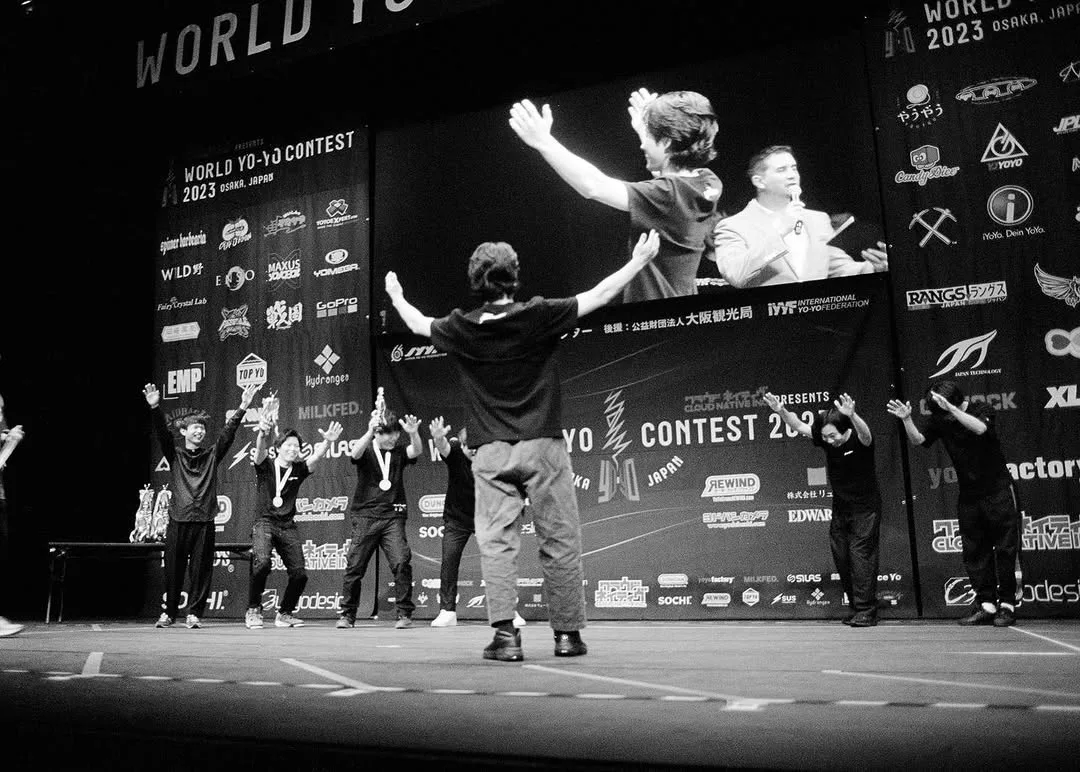
Competitive yo-yoing has evolved drastically since the boom of the late 1990s. Today, the World Yo-Yo Contest and regional competitions recognize five primary divisions of play, commonly referred to as 1A through 5A.
Here is a comprehensive breakdown of the different styles of play that define modern yo-yo competitions.
1A: Single Unresponsive (String Tricks)
The Standard of Modern Play
When you watch a modern yo-yo video online, you are almost certainly watching 1A. In this division, players use a single, “unresponsive” yo-yo. Unlike traditional yo-yos, an unresponsive yo-yo has a wide bearing and will not return to the hand with a simple tug. Instead, it spins indefinitely at the end of the string (a “sleeper”) until the player performs a specific maneuver called a “bind” to force it back.
- The Focus: Complex string mounts, slack tricks, lacerations, and rapid-fire technical combinations.
- The Yo-Yo: Wide, butterfly-shaped, unresponsive, and typically made of precision-machined aluminum, bi-metal, or high-grade plastic.
- Vibe: Highly technical, dense, and visually mesmerizing. 1A is the most popular and highly contested division in the world.
2A: Two Looping Yo-Yos (Double A)
The Speed of Sound
2A is often considered the most visually intense and difficult division to master. Players use two “responsive” yo-yos—one in each hand—that return immediately when tugged. The goal is to keep both yo-yos in constant, simultaneous motion, creating intricate looping patterns, wraps, and tangles without the strings catching.
- The Focus: Symmetrical and asymmetrical looping, continuous motion, around-the-world variations, and fast-paced choreography.
- The Yo-Yo: Narrow, modified-shape (often classic imperial or slightly rounded), highly responsive, and specifically tuned for consistent return times.
- Vibe: Rhythmic, explosive, and relentlessly fast. It requires thousands of hours of muscle memory to prevent catastrophic tangles.
3A: Two Unresponsive Yo-Yos (Triple A)
The Ultimate Multitasking
Invented in the early 2000s, 3A takes the dual-wielding aspect of 2A and combines it with the unresponsive string tricks of 1A. Players control an unresponsive yo-yo in each hand, weaving the two strings together to create massive, intricate mounts and knot-like formations.
- The Focus: Two-handed string tricks, kink mounts, spatial awareness, and preventing the two spinning metal objects from colliding.
- The Yo-Yo: Two identical, unresponsive butterfly-shaped yo-yos (usually 1A yo-yos).
- Vibe: Deliberate, highly complex, and punishing. A mistake in 3A doesn’t just mean a missed trick; it often results in a massive knot or a loud, metal-on-metal collision.
4A: Offstring
Breaking the Tether
If you’ve ever seen a diabolo (Chinese yo-yo), 4A will look somewhat familiar. In the Offstring division, the yo-yo is not tied to the string at all. Players launch the yo-yo into the air, perform tricks while it is in free flight or bouncing across the string, and then catch it back on the string to bind and return it to the hand.
- The Focus: Aerial acrobatics, whip catches, bounces, and large sweeping body movements.
- The Yo-Yo: Oversized, highly durable, bouncy plastic (like Delrin or polycarbonate) designed to survive frequent drops to the stage floor.
- Vibe: Theatrical, expansive, and high-risk. 4A players use the entire stage and rely on dramatic tosses that captivate audiences.
5A: Freehand (Counterweight)
The Unleashed String
Patented in 1999 by Steve Brown, 5A revolutionized the sport. In this style, the yo-yo string is not attached to the player’s finger. Instead, it is attached to a small counterweight (usually a plastic die, ball, or small character figure). Players let go of the counterweight, allowing the yo-yo and the weight to swing around each other in complex, gravity-defying orbits.
- The Focus: Aerial releases, 360-degree spatial play, nunchaku-like swinging patterns, and rapid transfers of momentum.
- The Yo-Yo: A standard unresponsive 1A yo-yo paired with a counterweight.
- Vibe: Flowing, dynamic, and rebellious. 5A completely changes the physics of yo-yoing, turning the string itself into a moving projectile.
The Specialty Divisions: Beyond the Big Five
While the 1A through 5A divisions test raw technical prowess within strict boundaries, the yo-yo community is diverse and expressive. To accommodate different demographics and creative philosophies, major competitions—including the World Yo-Yo Contest—feature special exhibition and non-championship divisions that have become massive crowd favorites.
Art & Performance (AP) Division
The Entertainer First
In the AP division, you are an entertainer first and a yo-yo player second. This is one of the longest-running “alternate” divisions, completely freeing competitors from the standard, strict technical point system. The yo-yo must still be an integral part of the performance, but players are encouraged to use it for comedy, drama, storytelling, or emotional expression.
- The Focus: Choreography, creative use of the stage, synchronicity with music, and audience interaction.
- The Format: Players or teams can compete using any style or combination of yo-yos, often incorporating elaborate costumes and props. Instead of a standard 1st, 2nd, or 3rd place, judges typically award specific honors like the Entertainment Award, Artistic Award, and Creativity Award.
- Vibe: Theatrical, expressive, and highly unpredictable. AP routines range from hilarious comedy sketches to breathtaking, emotional dance performances.
Women’s Division
Showcasing Top Talent
Historically, competitive yo-yoing has been overwhelmingly male-dominated. The Women’s Division (or Women’s Freestyle) was introduced to highlight, support, and encourage female participation at the highest levels of the sport. It has become a fiercely contested division featuring some of the most prominent and technically gifted players in the modern era.
- The Focus: World-class technical execution, clean trick evaluation, and representation on the main stage.
- The Format: Competitors perform a freestyle routine (usually two minutes) and can choose to play in any of the primary styles (1A through 5A). The scoring uses the same strict technical criteria as the main divisions.
- Vibe: Empowering and heavily competitive. The players in this division frequently compete in the main 1A-5A divisions as well, using this freestyle to further cement their absolute mastery of the toy.
Over-40 Division
The Veterans of the Spin
Yo-yoing is a lifelong pursuit, but a 15-year-old and a 45-year-old often have very different play styles and physical stamina. The Over-40 division was created to spotlight the older generation of throwers, specifically honoring the veterans from the massive yo-yo boom of the late 1990s, as well as parents who picked up the hobby later in life.
- The Focus: Legacy tricks, seasoned stage presence, and proving that precision and flow do not fade with age.
- The Format: Competitors 40 years of age or older perform a mixed-style freestyle (choosing 1A-5A). Because different styles naturally generate different amounts of points (e.g., 2A generates points faster than 1A), a mathematical coefficient is applied to the final scores to normalize them and make the competition fair. It is often split into “Open Class” for casual/newer older players, and “Master Class” for former world champions and elite veterans.
- Vibe: Nostalgic, respectful, and surprisingly intense. It is a celebration of the sport’s history, giving the crowd a chance to cheer for the pioneers who helped build modern yo-yoing.