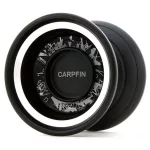
Qi

From ZGRT:

“(pronounced “chee”).

Qi is energy in the very broadest sense possible.

Qi is universal.

Qi embraces all manifestations of energy, from the most material aspects of energy to the most immaterial aspects.

Qi needs to have a balance in order to maintain good flow. If there is an imbalance of qi, energy cannot flow properly.

We started our journey with a remarkable H-shape yoyo because of the amazing properties and performance capabilities this shape can bring when in motion. This time, we wanted to bring another H-shape yoyo into our portfolio with a different style and design.

The Qi contains the typical characteristics of an H-shape yoyo where weight is pushed to the sides and comfortability comes very natural to the hand. For such reasons, we just wanted to enhance such characteristics and have a good weight (energy) distribution.

Let’s begin with the size of the diameter. The Qi could be ambiguously considered either a regular sized or an undersized throw depending on how the players considers it. For us, the Qi is in the maximum limits of what is considered an undersized throw in terms of size, but not in terms of performance.

The Qi plays very powerfully and nimble by properly utilizing the 62 gr. body weight along the thick rims that drive great performance. The centre of gravity of this throw is closer to the rims than the rest of the monometal throws we have designed.

Such factor allows the Qi to compensate the performance factor that a yoyo with a bigger diameter could provide. In a side-by-side comparisson with our Winglet, the Qi is 3 mm smaller in diameter, 2 mm wider and ~3 gr less in weight. The H-shape, altough is more conservative than the Winglet as it can be observed, it has been stylized with several subtle cuts that adds great personality to this throw. The catch zone of the Qi is wide enough to land tricks very easily.

The way the Qi has been machined is absolutely gorgeous. It has a very nice finish and smoothness that your hand will be happy to experience. The cup also has some cuts to aesthetically match the design of the rest of throw. It is also noticeable how we minimized the centre weight and left certain room for finger spinning. Thumb grinding will definitely not be an issue.

The engine and responsive system the Qi comes with are a concave C bearing and pads exclusively formulated for us in order to have a great spinning time and a nice grip. The Qi comes with Alpha line – ZipLine string.

We made this project with the intention to have a performer, handsome and comfortable throw that makes the energy to flow harmoniously.

Wish you a nice Qi entry flow and let nothing hold you down.”

Canopy SS

The following story was taken from the Canopy Collection website.


Taking even stronger reference from the Otter than previous Canopy instalments, primarily in its profile design, the Canopy SS is an undersized performer crafted out of stainless steel for added durability and torque. Optimising for characteristics native to the Otter, the Canopy SS has agility and quickness that are surprising for its specs – it’s all about outsized performance packed tight into a compact form.

Specs:

weight
67.5 g

diameter
50 mm

width
45 mm

Material:

Stainless steel

The release of the Canopy SS feels like a full-circle moment – the end of the beginning. We’re at the end of the year, and we’re also nearing the end of 2024’s release slate. The final instalment in Canopy’s design lineup is the Canopy SS, a model that might’ve been the most unlikely from the beginning – but also one that’s eventually evolved into a house favourite.

The four Canopy designs lean into various existing designs for inspiration, depending on their concept and material. The AL felt like a good, balanced blend of the Polaris and Otter form factors, the PC borrowed from the Arctica, and the Ti drew heavily from the Polaris. The fourth Canopy is the spiritual cousin of the Otter – Harrison’s second signature design by Caribou Lodge and Jeffrey Pang of Luftverk – but reimagined and forged in stainless steel.

Stainless steel is a tricky material to work with. It’s nearly twice the density of titanium and is incredibly rigid. That means it lacks the pliability of “friendlier” materials, such as titanium or aluminium, and design decisions have to be precise, since any mistake is significantly more pronounced – you can feel it immediately in play.

The accidental but fortunate implication of its characteristics, however, was that the Canopy SS had to likely be small. An overly large and dense design was a non-starter, given the Canopy ethos of everyday-ness; but a small form factor was an early concept cornerstone that bloomed beautifully into what the Canopy SS eventually became.

Given Harrison’s fondness for yoyos with a smaller physical footprint, we doubled down on creating a stainless steel design that sought to pay homage to the Otter – and that was the start of the design journey behind the Canopy SS.

It feels amiss to tell much of this story without Harrison’s own voice, so… here’s his side of the tale.

Take it away, Harrison.

Harrison here, momentarily taking over Reuben’s editorial to share a couple of my thoughts on the Canopy SS.

I try not to choose favorites, but the SS is easily my standout choice from the Canopy introductory lineup.

Let’s take a step back.

At the start of the year, when Reuben and I were brainstorming which yo-yos we’d like to release as part of the collection, it only made sense to lean into the overarching Technical Outdoors theme and use it to guide our yo-yo design philosophy.

Technical outdoor-wear brands often release variants of the same product, each geared toward different use cases and activities. While two products in the same lineup might appear identical on paper, their in-use performance can differ greatly, as they’re optimized for different objectives. For instance, maneuverability and breathability are often prioritized for rock climbers, whereas trail runners or trekkers might have entirely different priorities—even if there’s some overlap.

Yo-yo design has progressed to the point where top competitors can easily pick up almost any yo-yo released in the past few years and perform their full trick set. However, the variety in design lies in the details. Players whose trick sets predominantly feature challenging horizontal tricks will prioritize different design characteristics than those of a tech flow player. This is why so many options exist today—but if you’re reading this editorial, you already know that.

While shape and weight distribution have historically been the primary design levers, experimenting with and prioritizing materials has been relatively uncommon.

So, we decided to create an ambidextrous shape—one that could be optimized for both competition and casual play—drawing inspiration from my signature yo-yo, The Otter, and the Atmos Polaris. The question became: How could we lean into the unique properties of the material a yo-yo is made from to enhance performance for specific use cases while maintaining a consistent shape and overall design?

Aluminum and titanium were easy picks, along with machined polycarbonate, inspired by Atmos’s recent Arctica design. But the thought of exploring stainless steel as a material felt a little riskier. Drawing inspiration from the DINK by Jake Bullock and the Apathy by Empathy, we knew it could be done and result in a yo-yo that played distinctly differently from the rest of the lineup.

I immediately had a feeling the SS would be my favorite after Reuben sent me the specs.

With The Otter, Jeffrey and I aimed to create a yo-yo that matched my fast and technical playstyle: something that could handle multiple string wraps and intricate string maneuvers with ease. We wanted a yo-yo with a long spin, the ability to maintain plane through lengthy combos, and incredible agility—capable of changing direction with little to no resistance. This led us to designing an undersized competition yo-yo.

The SS is, in many ways, a progression of my initial set of requirements for The Otter, adapted for 2024. Its even smaller diameter allows you to use a shorter string for greater control without compromising maneuverability. And using stainless steel as a material allows for a more precise weight distribution impossible with aluminum, making it feel much larger in play than its small form factor suggests.

Backpacking around East Asia this fall, the SS became my go-to pick for daily adventures. It was something that could easily fit in my crossbody bag. The outsized performance of the Canopy SS, led me to choose for my demo at AXEL—here it is in action.

The Canopy SS features design cues native and now recognisable to Canopy – such as the Otter’s half-spike, albeit compressed, and a lot more subtle; it also features the gentle, topological profile lines from the Polaris. However, the profile wall is a lot more curved than is regular for a Canopy – it opens up a wide, friendly chasm for string hits, and also pays homage to its forebear in the original Otter design.

It’s obviously related to the lot, but it bears closer resemblance from one side of the family.

The weight distribution is decidedly even, which means that even at 67.5g, it moves extremely confidently, but it’s sprightly and quick. It’s far from a tiny brick that its mass might suggest. It’s nearly a full gram heavier than the Canopy Ti – but it moves much, much faster.

At 50mm it might be hard to imagine something so stable and powerful, but for its physical profile – its performance is genuinely outsized.

We’re incredibly excited to bring you the Canopy SS – a product of over thirty drafts and multiple prototypes, a real pocket rocket, and perhaps the best way to wrap up an incredible year of new things.

If you’re still here – thank you so much for being a part of the journey. 2024’s been an incredible ride, and we couldn’t have gotten here without you.

We hope you enjoy this one.

Canopy PC

The following story was taken from the Canopy Collection website.


The Canopy PC takes on fun in a big way. Drawing inspiration from Atmos Projects’ recent plastic release in the Arctica, this third entry in the Canopy Collection is constructed with precision-machined polycarbonate, and takes a step into the oversized category — all while offering precise, nimble handling.

The Canopy PC is designed for dynamic and rhythmic control, and is an everyday favorite that is larger than life.

If you missed our earlier editorial on the design process that started with the Canopy AL, you can check it out here.

We’ve designed, manufactured, tested, assembled and played with a ton of yoyos over the years – but there’s just something special about a plastic yoyo. It’s not just about nostalgia – no shortage of rabbit holes there, if you wanted to go down one. The truth is, plastic yoyos are just more fun. It’s just science. They make you play differently, and even if you did the same tricks on them that you just performed on your newest, shiniest competition bimetal a minute ago, it makes you feel different. Plastic yoyos are the ones you throw in a backpack or keep around the house and don’t think much about, but they feel right for every spontaneous session when inspiration strikes – and they’re always a satisfying throw.

Specs:

weight
68.2 g

diameter
58.7 mm

width
49.1 mm

Material:

Polycarbonate

Shortly after the Canopy AL and Ti were put into production, we set on a path to develop a couple more designs to round out our first iteration of the Collection. Following the material study we had begun, we eventually settled on making a plastic Canopy – an intriguing proposition for multiple reasons. For one, using plastic as the chosen material meant that we would deviate from certain aspects of the Canopy form factor quite significantly – given the vast difference in material densities and characteristics, we knew right off the bat that an undersized profile, or the dipped angle rim feature, were unlikely to feature in a similar way.

A plastic Canopy would look very different, which was an exciting thought. It also gave us permission to be more liberal with our imagination in terms of the design concept – the AL was built with an everydayness in mind; the Ti is technical and more performant. A plastic Canopy would be built for very different purposes and outcomes.

And so we got into the usual rhythm of late evenings on our CAD programs and a hundred Telegram messages across time zones. The kicker in all of this was – we had just spent the last half year working on the Arctica, Atmos’ first ever polycarbonate model.

The Arctica was an exercise in precision – as a model consisting of 12 independent precision-machined pieces, we learned a ton about material tolerances, designing for fit, and how to apportion mass with a material so light. So much of what we learnt was ready to be exported and mapped over to this new design that was taking form.

We eventually settled on polycarbonate, a material we’ve grown to really love. It’s light and soft to the touch, but structurally rigid enough – it generally lends to much smoother play than other types of plastic, and also produces a wonderfully frosted look after it’s been machined. The one challenge using polycarbonate is that it can sometimes be too light – more on that later.

The prototype we sketched up was 58.7mm in diameter and 49.1mm in width, and about 68.2g in mass. These numbers may look absurd at first glance, but rest assured they’re not as extreme as they seem. The Canopy PC sits fully in the hand at 58.7mm, but it doesn’t feel overly large. The softness of the polycarbonate makes it a full and gentle catch; just like holding a softball in a glove. The 49.1mm in width also feels natural by proportion– it’s hard to miss a trick landing with something that wide. The weight is where some of our learnings from the Arctica came in handy – we knew we needed a disproportionate mass, paired with a large diameter, to compensate for the low material density of polycarbonate. Leaning towards a lighter overall weight – say, in the “normal” ballpark of 64g to 66g – would lead to a thin and hollow playfeel. To that end, we drew up massive beefy rims that take inspiration from previous Canopy iterations – they’re about 12mm thick, and pack a solid punch.

The resultant mass of 68.2g makes the Canopy PC feel full, incredibly stable, and surprisingly nimble. Perhaps the most impressive trait of the Canopy PC is how precise and nimble its handling and control is, particularly for its size – it responds to dynamic and rhythmic manipulations very, very well.

We also integrated the iconic Otter hub into the aluminum spacer assembly. This was a design feature we were unwilling to do without – it gives the yoyo a distinctly Caribou Lodge look. Where there usually is just a simple nub, or a dimple for finger spins, the Otter’s half-spike is carved into a 6061 AL fitment and is embedded into the polycarbonate body, concealing the remainder of the spacer assembly. Beyond its mechanical and symbolic functions, we were also just in love with how the aluminum half-spike looked paired with the frosted polycarbonate hub.

We machined a first run of prototypes and got them just in time for WYYC 2024. These prototypes were quickly sent out to the Canopy team for testing – individually, but also at the largest annual event of the year in the yoyo world, where some of the best players globally were gathered for a few days. Harrison and Coleman were split between organizing the Stargazing Night event (a Herculean task in itself) and getting the Canopy PC in the hands of players we wanted feedback from. Harrison compiled a list of feedback and insight on the Canopy PC that ran 18-lines long – most of them converging around the balance, optimum weight distribution, and solid playfeel. In contrast to the Canopy Ti, which went through four rounds of prototyping, the Canopy PC prototype got pretty close to where we hoped it would be on the first try – something we were incredibly grateful about.

The production version of the Canopy PC has a couple of quality-of-life adjustments that optimize for smoothness and feel; it otherwise remains faithful to the prototype we first made.

For many reasons, the Canopy PC might just be my personal favorite of the lineup so far. It’s sat in my rotation ever since I got my hands on it. It’s the big, bouncing, bubbly younger brother of the family who’s naturally hilarious and just knows how to have fun, and everybody wants to be around. It whips, whizzes and weaves effortlessly, and is everything you need it to be.

It’s accessible, and it’s for everyone.

Come enjoy the Canopy PC.

Canopy Ti

The following story was taken from the Canopy Collection website.


Shortly after we got the Canopy train going, our conversations quickly turned to defining the scope of the project. We were committed to the “Canopy” form factor, which was fundamentally a blend of the Polaris / Weatherman profile with the Otter’s iconic hub design.

In one conversation, the notion of a material study surfaced, and it gave us a unique framing for our design approach. What would the Canopy form factor look like – designed, crafted, and optimized in different materials?

In case you’ve missed an earlier editorial on the design process that began with the Canopy AL, check it out here.

Reincarnating a design in a different material isn’t as straightforward as shoehorning the same blueprint and adjusting it for weight and size, and then slapping a material label on – it’s having to reconstruct the essence of something that exists from the ground up with entirely new parameters, being sensitive to the way different materials transform a user’s physical experience, while prioritizing faithfulness to what has come before.

Specs:

weight
66.6 g

diameter
53.9 mm

width
46.0 mm

Material:

TITANIUM

The Canopy Ti was actually designed alongside the Al – we started sketching them up side-by-side, and the original intention was to prototype and test them together. While the AL sat at 54.9mm in diameter, its titanium brother was scoped at 53.9mm in diameter, by personal request of Harrison – a step closer to the undersized genre, and more akin to the Otter’s profile. The smaller, unassuming footprint was an important requirement – to keep faithful to the ethos of the “everydayness” of Canopy, it had to be something that slipped easily into somebody’s carry.

Welcome to our first prototype – Canopy Ti 1.0.

The result of an early design sprint was the decision to include polycarbonate caps, which could be removed and swapped out for different variations of weight.

This was entirely a moonshot design, influenced by the modularity and utilitarianism of modern outdoor gear, and the intention was to also manufacture compatible caps out of various materials at later stages – even ones made out of oak and maple. The concentric cap design was also influenced by existing Caribou and Atmos designs, in the Beartrap and Fruitloop, but adapted for an industrial, minimalist look. We were excited about how it looked, but as a more complex composite design with a myriad of unknowns, the eventual verdict of the design depended on how it felt in play.

The 1.0 Prototype arrived in my hands, as well as Coleman and Harrison’s, just in time for their West Coast Road Trip (again, not without the requisite drama that seems to follow our adventures with shipping across continents). Fairly quickly, with some testing, we realized 1.0 needed more development. It was too heavy and too clunky in play. The 1.0 has a slight old-school charm that would appeal to players who lean towards undersized, heavy yoyos. We canvassed a list of tweaks we knew would set the design straight, but after some consideration, we eventually agreed we would be perfecting a design that would ultimately be too niche and specific for general release. We needed the Canopy Ti to be universally familiar, comfortable and fitting in any hands.

For what it’s worth – this might not be the end of the 1.0. It’s temporarily shelved, but if inspiration strikes, we just might pull it out of the design archives to get it right for a small-batch release.

Starting with a moonshot design is always fun, and brings with it a ton of learning. Still, our primary course of correction was in aligning more faithfully to the original Canopy form factor, which sadly meant doing away with the caps – at least for our first production version.

We went back to the design table, and sketched up Prototype 2.0. In replacement of the cap-system, Prototype 2.0 featured a similar rim design that makes an appearance on both the Canopy AL and Polaris. Without caps and the seat that enclosed it, the base structure of the Canopy Ti was significantly lighter. While we reapportioned most of that mass in its angled, dipped rim, we ultimately reduced its overall mass, with the prototype eventually weighing north of 64g.

A month or so later, the 2.0 prototype arrived in our hands. It was a marked difference from 1.0 – it felt significantly more agile and maneuverable, but ultimately it still felt shy of what we had imagined. It was a touch too light – but not the desirable sort of litheness that good featherweight designs have. It gave us the same feeling we had with the first Canopy AL prototype – it just didn’t feel full and whole.

From Switzerland, where he was at the time, Harrison wrote in with his thoughts,

We were learning a ton about the Canopy AL together in real time. Feedback clustered around the consensus that the first prototype was enormous fun. The key attributes that most players loved about the prototype were its agility, stability and a floaty touch. Steve wrote in saying he found the prototype delightful and a joy to play; zippy, but not uncontrollably so, and felt lovely in the hand.

We quickly adjusted the design file for a third prototype that had more weight in the midzone and rims, and sent it for yet another round of proofing. Unfortunately, while those changes fixed the issue of playfeel, we ran into more technical issues on the machining front, which made it difficult to machine a large batch of smooth Canopy Tis.

By this time, it had been months since we first sketched up prototype 1.0 – and it had already undergone a transformation so significant, they were night-and-day from the first sketch. We were close – but we needed one final go to get it just right.

We took another few weeks of close study, comparing the CAD files of previous designs and tapping on to learnings and technical notes from years past – and finally submitted a blueprint for Prototype 4.0 – our fourth, and final iteration of the Canopy Ti.

It sported major adjustments in the weight distribution and material reinforcements in crucial areas – tweaks that drew heavily from experimentation that we did with the Polaris. The Polaris was a natural reference here, since the Canopy draws from it as a design inspiration. This version clocked in at 66.6g – but in motion it feels a lot lighter than that. In play it feels closer to a 65g yoyo.

It’s fluid, incredibly agile, and paces very well. It’s comfortable in the hand, plays easy, but its minimalist looks hide an incredibly functional and utilitarian design.

On the production version, Harrison wrote,

The Canopy Ti doesn’t take itself too seriously, but excels when you need it to.

We’re very proud to bring you the Canopy Ti – a design we’ve worked incredibly hard to perfect, and one that belongs in every player’s rotation.

Canopy AL

The following story was taken from the Canopy Collection website.


Some time in October last year, Coleman and Harrison met up in Seattle to hang out and to work on the sixth chapter of We Got This – a video series that stories a friendship that has spanned 13 years. Out of one of the many conversations between Coleman and Harrison came the seed idea of a collaboration between Atmos Projects and Caribou Lodge – a prospect that was incredibly thrilling, as Caribou Lodge has been a company we’ve long admired.

There were more conversations to be had before Atmos Projects x Caribou Lodge 2024 was a sure thing, but there it was – the beginning of a new, exciting, and slightly unfamiliar journey.

Weeks in, as the collaboration between both sides started being officially on the cards, I was introduced to Harrison over a Zoom call. First meetings discussing an ambitious project can sometimes be chaotic – in the best of ways. You’re trying to reach for the highest possible ceiling while simultaneously establishing a realistic floor you can execute on. One of the first questions we were trying to address was what project concept would make any sense for both brands. We could sketch up any model we wanted, even do a reinterpretation of our most popular models to date, possibly for maximum effect – but it felt like the most crucial thing to everyone on that call was making something that would resonate equally in both universes; something that would feel at home for both brands.

Another question that surfaced, perhaps non-verbally, was – how do you make something exceptional? Moreso, a physical product that accounts for nuances of feel and motion – when you’re halfway across the world? It turned out that half of the answer is a hundred late night Zoom calls and Telegram messages across time zones; the other half is developing a shared vocabulary for common references and description.

Specs:

weight
65.3 g

diameter
54.9 mm

width
46.0 mm

Material:

6061 AL

Harrison took lead in representing Caribou Lodge in our discussions, and we found out pretty early on that the three of us shared a love for the outdoors, and an accompanying appreciation for well-designed, thoughtful gear that keeps us safe and comfortable on those adventures. They don’t necessarily optimize for maximal performance, as a serious alpinist might look to do, but they sat in a category of incredibly functional, and utilitarian kit that seemed to fit every occasion with ease. Something you just wanted on every trip, something that felt like a good friend you brought along on adventure, something that just felt good.

Having shared reference and language here was extremely helpful, especially in trying to communicate, in very abstract terms, the “feel” of what Canopy should be.

Earlier, Coleman had commented that Harrison might enjoy the play of our latest titanium release, the Polaris – and so I sent one to him as a gift, and for feedback. Consequently, many of our design conversations surrounded features of the Polaris, as well as the Otter, Harrison’s signature model. The conversations naturally progressed to the possibility of merging certain features of the Polaris with the Otter, with major, intentional adjustments to the way it felt in hand and in play. Having both the Otter and Polaris in hand as common references, we were able to triangulate and zone in on a feel we were looking for. For one, Harrison mentioned the Polaris was a touch heavy for his taste – we settled on designing for something that would feel a lot more even.

Canopy AL prototype, next to my battleworn Polaris

We agreed on 54.9mm diameter and 46.0mm width as base parameters, and mass was to sit roughly in the high-64g range – and started sketching up the blueprint of our very first design, the Canopy AL. We embarked on a crazy design stretch – a period that featured working on CAD blueprints while transiting between flights in Suvarnabhumi Airport in Bangkok, Thailand, hammering out refinements on weight distribution, hoping to get as close to perfect as we could on our initial prototype.

One thing I’ve always admired about Caribou Lodge is the attention to detail. It’s rare for companies to be so comprehensive and integrated in their design language that you can immediately tell a design belongs to them. Wanting to honor the Caribou Lodge heritage in this shared project, part of the design process included a serious study of a handful of Caribou Lodge’s designs and CAD blueprints, and getting a good, concrete sense of design decisions and how they bore out in the way they played. One of the most iconic details of Harrison’s Orca and Otter models was the short, fat half-spike, surrounded by a raised moat that transitioned to a clean cup – a feature that has since become recognizable. Another aspect of Caribou Lodge throws is a signature fullness of feeling on the throw. One wouldn’t describe it as dense, but extremely whole – this playfeel would be something that featured prominently further along the journey. More on this later.

We integrated the iconic hub design of the Otter with the minimalist silhouette and rim structure featured in the Polaris, but scaled it to an appropriate thickness for 6061 aluminum. The profile features subtle step-lines that lead to a fat, angular-overhung rim that contains a deceptive amount of mass – a recipe that’s worked beautifully in the Polaris, as well as the Ekta.

CAD files were promptly shipped off to our machinist, and a batch of prototypes (the same ones that have been floating around, most recently at US Nationals) were completed after some wait.

They were ready for testing all across the West Coast Road Trip that Coleman and Harrison were about to embark on – the prototypes would get to them just on time, but not without some drama. Other prototype units were sent out to the Caribou Lodge and Atmos players internationally, and so we sat back, ready for testing and feedback that would come our way the next few days – and feedback did start pouring in.

We were learning a ton about the Canopy AL together in real time. Feedback clustered around the consensus that the first prototype was enormous fun. The key attributes that most players loved about the prototype were its agility, stability and a floaty touch. Steve wrote in saying he found the prototype delightful and a joy to play; zippy, but not uncontrollably so, and felt lovely in the hand.

While we were in the right ballpark, a single point of improvement emerged amidst the other positive responses – it needed a touch more midweight. It was something that revealed itself only after a fair bit of play – when a player got past a point of saturation.

Days of additional testing confirmed this – players that Coleman and Harrison met on their road trip confirmed that while the first prototype played a treat, there was a desire for an additional smidge of weight – requests ranged from 0.5g-1g. We went back to the CAD and made some tweaks to the design – we threw in some quality of life refinements, but the most crucial change was a redistribution of a touch of mass towards the midzone, placing the revised version at an even 65.3g.

The changes made are visually imperceptible, but the differences in play are very pronounced. The revised version felt more consolidated, and had more presence – in the words of Harrison and Coleman, more “complete”. It felt a touch heavier on the throw at first compared to the first prototype, but after it got up to speed, it moved with the same fluidity, and hummed along with an easy confidence. Apportioning more mass to the midzone eliminated any of the “thinness” that could be felt after some play, and the new playfeel felt just right.

The Canopy AL was never meant to be a “min-max” design by philosophy; it never attempted to optimize in that direction. It ended up feeling capable of competitive performance, but still possessing an organic, homely essence to it. Going back to our early conversations about outdoor gear that just felt right, the Canopy sat in that zone of something you always wanted on hand, something that just felt good – like a good, well-worn Gore-Tex jacket, reliable and useful in every situation.

This is subjective, of course – but I personally felt our second version came a lot closer to the recognisable feel of Caribou Lodge models, which have this slightly old-school solidness and fluidity about them.

The wonderful thing about collaborating with others – what more with amazing, talented, and good people, such as the folk from Caribou Lodge – is the perspective you’d otherwise never have. The journey so far in developing the Canopy AL (and many, many other things we have in store) is such a departure from regular programming – but we’re so proud of how the Canopy AL has turned out, and we’re incredibly excited to share this with you.

The Canopy AL was designed for you. The Canopy ethos, “Everyone’s Covered”, was cleverly articulated by Coleman, and speaks to the connection and everybody-ness of our small, but wonderful, inspiring, and diverse community – we’ve experienced that in some small way working on Canopy Collection. The Canopy AL blends performance and fun, and is a reminder to get up, play, create, and to just go with the flow.

We hope you enjoy this one.