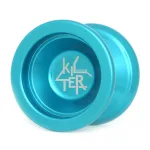
The Martian!

MARTIAN INVASION!

As we approach the end of 2022, I reflect on RSO’s year which has been relatively uneventful, with only 6 releases compared to the 16 in 2021.

It has been slightly over 4 years since RSO’s first yo-yo, and manufacturing costs have increased tremendously. Although it no longer makes financial sense to continue operating RSO, my passion for yo-yo design has been crucial in keeping the company going. In addition, I still enjoy brainstorming the theme and artwork behind each model, particularly for models like Sushi and now The Martian!

The Martian has been a long time in the making. The prototypes were completed in January 2022, and the production batch shipped to me in June 2022. Unfortunately, the release was delayed indefinitely due to a critical manufacturing defect in the Side Effects (SE) hole. The SE could not fit, and the yo-yos had to be redone.

I am glad to finally show you my creation six long months later.

This is a special yo-yo. It is difficult to accurately describe the playfeel of Martian – it is neither floaty nor solid playing, but it has plenty of… soul. If you’ve thrown a Canvas, which the Martian is heavily based on, you’ll know how it feels. The Martian plays slightly heavier with more center weight compared to the Canvas, with a very peculiar bounce when it hits the string. Every now and then, an RSO yo-yo with a seemingly simple design blows me away, and the Martian is one of them. It is up there with derti, TiRAMiSU and Sushi as my favorite RSO releases.

It must be emphasized that the yo-yo is not wholly vibe-free. I attribute this to the relatively large, full-sized diameter of the yo-yo, which increases the risk of warping during the machining process. The yo-yo is smooth on the string and outer rims but has a slight unnoticeable vibe if you place two fingers in the catch zone near the response area. I applied the same quality control standard as Gravity – so you would be happy with Martian if you were satisfied with your Gravity.

THE BIG BANG

Martian is a fusion between the RSO x Atmos Projects Gravity and CLYW Canvas.

The initial Martian CAD resembled more the Gravity than Canvas. I wanted the caps made for Gravity and Sushi to be backwards compatible with Martian, but it was impossible. The diameters of Martian, Gravity and Sushi are 55.5 mm, 54 mm and 50.5 mm respectively – the larger diameter of Martian meant that more material had to be located at the rims to accommodate the comparatively small caps, which resulted in an unacceptable increase in the yo-yo’s weight.

I felt that fabricating new, larger caps for the Martian would not be wise as the groove for the caps would only be compatible with one yo-yo, lacking versatility. On the contrary, the cap grooves on the Gravity and Sushi are more universal as they can also accommodate Freehand Zero caps.

The production version of the Martian has a Gravity-like hub and a similar curvature to the inner rim.

Gravity (left) and Martian (right).

After I removed the cap grooves, the Martian CAD evolved into one looking more like the Canvas than Gravity. The response grooves, surrounded by deep Schmoove grooves, accommodate CLYW / G-grip sized type 50 Landing Pads, with which I have a love-hate relationship.

On the one hand, the pads have a larger diameter and give the yo-yo slightly more momentum and longer spin time. On the other hand, they are thicker than your regular 19mm pads, necessitating more material in the center of the yo-yo to accommodate them. The broad and deep Canvas-like Schmoove grooves negated this issue in the Martian.

Gravity (left) and Martian (right).

The Martian has Canvas-like walls, which are higher than Gravity’s. The Martian is about 1 mm wider in diameter and width compared to the Canvas.

Gravity (left) and Martian (right).

The inner rims on the Martian also feature a triangular-shaped protrusion, similar to that of the Canvas. The outer rims, on the contrary, are slightly rounder than the Canvas. The Martian feels “fatter” in the hand.

Gravity (left) and Martian (right).
Canvas (left) and Martian (right).

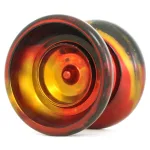
The production version of the Martian is essentially a slightly wider, slightly larger diameter, plumper titanium SE Canvas with a Gravity hub.

UNPARALLELED IN THE GALAXY

As with all RSO SE models, Martian is powered by original One Drop SE and premium Yoyorecreation NSK platinum Double Straight bearings.

In addition to the brass ultralights SE installed, a pair of aluminium ultralights SE are included with every Martian. With aluminium ultralights SE installed, Martian weighs only 62.7g and handles fast trick combos better. However, I prefer the heavier playfeel with the brass ultralights SE installed.

I contemplated shipping Martian with Energy Dome SE, which resembles the muzzle of the Martian brain disintegrator from the film Mars Attacks!, but eventually decided against it as it didn’t fit the overall look.

MARS ATTACKS!

https://youtube.com/watch?v=BB61nauFkds%3Ffeature%3Doembed%26enablejsapi%3D1

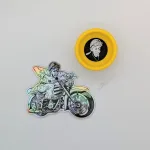
The artwork was drawn by ATILA, a long-time collaborator of ours. ATILA and I are big fans of the Mars Attacks! movie and felt that we could do a spin on the art for The Martian! Despite an ensemble cast of A-listers, the film did not perform at the box office but eventually became a cult classic. On the cover, we have RSO’s ambassador, Hachiko, trying to defend planet earth from the attacking Martians.

WHAT’S IN THE BOX

A PAIR OF ALUMINIUM ULTRALIGHT SE (IN ADDITION TO THE BRASS ULTRALIGHT SE INSTALLED)

MARTIAN INVADER ENAMEL PIN

Certificate of AUTHENTICITY

A PAIR OF CLYW SLIM / G-GRIP SIZE TYPE 50 RSO LANDING PADS

RED STRING

Makisushi

Makisushi is a special edition of the hugely popular Sushi yo-yo, based on the same CAD. Sushi ranks amongst my top RSO releases, not only because of its unique playfeel but also due to my love for the sushi delicacy and Japanese culture.

The yo-yo was intentionally designed to resemble a sushi roll, which is also known as “makizushi” or “makisushi”.

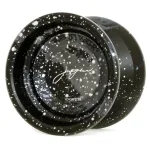
The anodized black cracked hard coat finish on Makisushi is reminiscent of the seaweed, or “nori”, used to wrap around the sushi rice. The “cracks” on Makisushi have a gold hue, in contrast to the ones on the Mecha-Viszilla SE Edition, which have a silver hue. Unfortunately, I could not make a larger run of Makisushi due to the high-risk nature of the anodization process.

Fun fact: Nori comes in different grades. As a general rule of thumb, the darker the colour, the better. Higher grades have a jet-black hue.

Makisushi will ship with the same components included with the raw Sushi run.

Note: Due to this yo-yo’s anodized coating, the finish may wear if the caps and rings are repeatedly installed and removed. For the same reason, the caps and rings are also slightly tighter on Makisushi than its raw counterpart.

Bowl Mg

The Bowl Series needs no introduction. It is the most popular RSO range to date. Since the release of the original titanium Bowl in August 2018, there are now nearly 800 Bowls in their various iterations in the yo-yo community.

Its simple yet versatile structure sets the Bowl apart, allowing me to experiment with different metal alloys without the limitations of Side Effects, bimetal rings, or extreme weight distribution. Except for Bowl 303, the formula for the Bowl Series is elegantly straightforward – proportionally adjust the thickness of the walls of its predecessor based on their densities, fine-tune the curves and angles, and it’s ready to go.

I’ve never explicitly mentioned this before, but the goal of the Bowl Series was never to create yo-yos with identical playfeels. Instead, it was to produce visually similar designs using different materials to create a diverse range of play experiences. As a result, each Bowl may look similar to the others, but they are uniquely crafted to deliver contrasting playfeels.

MAGNESIUM IS FOREVER

Let’s start by addressing the proverbial elephant in the room. Some have questioned the use of magnesium for yo-yos, as it’s only slightly denser than delrin (1.8 vs 1.4 g/cm3). On the surface, it may seem like a no-brainer to opt for delrin instead. However, it’s not quite that simple.

A delrin Bowl simply wouldn’t have the same look and feel of a Bowl. Achieving adequate spin times would require a metal insert to form the bearing seat. We had Crucial SPR spacers in the past, but they wouldn’t hold up against today’s yo-yos. Nowadays, most delrin yo-yos incorporate a metal nipple/hub, usually made of anodized aluminum. Atmos Projects has cleverly tried to mask the metal hub with a machined delrin cap with the Snowberry, but it’s impossible to achieve the Bowl’s signature clean bump at the hub area with this method.

But it’s not just about aesthetics – magnesium offers a wholly different playfeel compared to delrin. It’s like holding a piece of expensive pottery with all the physical properties of a metal, making magnesium an exceptionally unique material. Plus, when tapped on or in contact with the string, a magnesium yo-yo emits a high-pitched “ting” of a typical metal yo-yo that sets it apart from its delrin counterparts. You could quickly tell them apart even if blindfolded.

Injection-moulded polycarbonate would help maintain the Bowl’s sleek design, but it’s about a third less dense (1.2g/cm3) and feels significantly cheaper than delrin. Polycarbonate yo-yos I own tend to get tossed into random storage boxes and lack the collectable factor, unlike their higher-end counterparts.

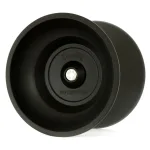
Bowl Mg is a stunning yo-yo that beckons to be held. Its exquisite, almost white/light grey matte finish is a sight to behold, unlike anything you’ll find on other metal alloys. Unlike the shiny, subpar feel of white powder-coated aluminum yo-yos, the Bowl Mg’s finish is akin to the revered Yoyofriends Moon Rock finish – I don’t own any of Yoyofriends’ yo-yos, but the Bowl Mg appears to be just a hair closer to white than the Moon Rock aluminum ones.

But it’s not just a pretty face – the magic happens when you start throwing it. This yo-yo’s playfeel is nothing short of nimble and airy. The weight is evenly distributed thanks to magnesium’s low density, giving it a distinct, almost “fluffy” movement signature on the string and impressive hang time. It’s like playing with a yo-yo made of marshmallows or helium – I even tried levitating it with my mind, but my skills have yet to master that feat.

Bowl Mg comes with CLYW/G-grip sized Landing Pads that provide some notable benefits. These pads are wider in diameter, allowing for greater string contact surface area and consequently more momentum and a longer spin time. However, compared to standard 19mm pads, they are also thicker, requiring additional space at the center of the yo-yo to fit them in. Thankfully, the low density of magnesium provides ample material for accommodating these pads.

ON CLOUD NINE

Players will be intrigued by the nuances that distinguish the various Bowls available. Among the stainless steel, titanium, 7068 aluminum, and magnesium options, their respective densities are 7.65, 4.51, 2.81, and 1.8g/cm3, with magnesium being the least dense.

Although Bowls do not fall under the category of rim-weighted yo-yos, the titanium Bowl boasts the most significant rim weight, while the Bowl 303 exhibits the most center weight. The Bowl 7068 sits between the titanium and 303, and the Bowl Mg falls between the 7068 and titanium options. It’s important to note that there were some deviations from the Bowl formula for the 303, as the high density of stainless steel posed challenges in proportionally thinning down the walls of the yo-yo, compared to the titanium and 7068 aluminum counterparts.

The weighting spectrum of the Bowls is best represented visually below:

The weight distribution of the 303 is noticeably different from the rest, with the Ti not being its direct opposite. In contrast, the Mg feels more similar to the Ti than the 303 due to its more “homogeneous” weight distribution.

Aesthetics and playfeel are two facets that set the 303 and Mg apart. If one were to draw an analogy to describe their movement signature, the Mg could be likened to a featherweight helium-filled balloon, while the 303 resembles a substantial water-filled balloon. The Mg flits about with ease, dancing with the slightest nudge, and conveying a sense of weightlessness. In contrast, the 303 bounces around with a more deliberate pace and weightier sensation, requiring a more conscious tug to guide it.

The differences in density and weight distribution give each Bowl a distinct performance characteristic, and examining these distinctions can assist you in discovering the ideal Bowl that matches your yo-yo preferences. During a recent visit by Reuben from Atmos Projects, he tested all the versions of the Bowl and concluded that Mg and Ti, both of which he now owns, were his preferred choices. Shimon Osada, an RSO collector to whom I sent a Mg prototype, favors the 303 but frequently uses his Mg as an alternative. I am sure other players will have contrasting viewpoints, as I personally find it difficult to pinpoint my favorite one – they are all my babies.

BACK TO ORIGINS

The arrival of the Bowl Mg signifies the culmination of the Bowl’s journey, bringing it full circle. It bears a striking resemblance to the I Love YoYo (ILYY) 2WEI, which was the main inspiration for the Bowl series. I hold the 2WEI in high regard and am fortunate to possess all iterations, including the original grey and updated blue and green models. However, despite the similarities in appearance, the Mg and 2WEI differ significantly in their playfeel. Depending on the production run, the 2WEI weighs between 67-69g.

DITTO

The Bowl Mg is not without its flaws. The problem with raw magnesium is that it oxidizes very quickly and poses a challenge during the anodization process. Regrettably, my machinist was unwilling to divulge the techniques required to attain the ideal coating for magnesium yo-yos.

I was particularly struck by the varying surface graininess of the Bowl Mg halves. It took significant time to meticulously match halves with comparable textures. Roughly one-fifth of the run boasted a stony, grainy texture akin to the ILYY candy blast (I am naming this finish “Rambo”), while the remaining majority possessed a smooth and velvety feel reminiscent of blasted aluminum yo-yos. It’s worth noting that the velvety finish ones also have small grainy patches that can only be detected when held in hand and are not discernible visually. I would be giving customers an option to choose either finish, but the velvet one is the “standard”.

Except for General-Yo’s Magnum, Kyle Weems’ Death Robot Mg, and Yoyofriends’ Cloudstrike, I believe I have collected the majority of magnesium yo-yos currently available on the market. This comprehensive collection allows me to compare and contrast the Bowl Mg with magnesium yo-yos from various other brands. One should note that all of the yo-yos in my possession are A-grades and were purchased either directly from the manufacturer or through authorized retailers.

One thing for sure is that Bowl Mg does not feel as smooth as the surface of the Freehand Mg. Despite its appearance of uneven bumps and ridges, the surface of the Freehand Mg is exceptionally smooth to the touch.

Turning Point, a company renowned for their rigorous quality control, sets the benchmark for magnesium yo-yos. They have released more magnesium yo-yos than any other company worldwide. It is common to observe black speckles on Turning Point’s magnesium yo-yos.

Though present, the Bowl Mg’s black speckles are similar in subtlety, if not less visible than those found on Turning Point’s magnesium yo-yos. The speckles are not visible in the images of the Bowl Mg above since capturing them with a camera requires a focused effort. Additionally, the Bowl Mg’s white shade is similar to that of Turning Point’s magnesium yo-yos.

Turning Point Mgksa with black speckles on the hub, one which appears more prominent.
Turning Point Alnilam, with a black speckle on the catch zone.
Turning Point Radix, with black speckles in the hub.

One of my favourite yo-yos in the collection, the sOMEThING Anglam MGSS, is similarly affected.

Anglam MGSS with white blotches and black speckles in the hub.
Anglam MGSS with black speckles on the rim.

Although the imperfections mentioned above may catch one’s eye, they are far from diminishing the allure of the stunning white aesthetic that magnesium yo-yos exude. I am happy that the finish on the Bowl Mg is on par with the industrial standard.

ART BY ATILA

ATILA is the mastermind behind the artwork, showcasing RSO’s beloved sloth with a bowl cut, none other than Owen, who has been prominently featured on previous full-sized Bowl releases. In this latest iteration, Owen has taken on the guise of Rambo in a dense jungle landscape, brandishing a formidable machine gun (“Mg”) as he embarks on a clandestine mission.

WHAT’S IN THE BOX

RSO SPECIAL FORCES ENAMEL PIN

TOP SECRET MAP Certificate of AUTHENTICITY

A PAIR OF CLYW SLIM / G-GRIP SIZE TYPE 50 RSO LANDING PADS

RED STRING

Rainbowl 303

The following was archived from RSO’s website:


Rainbowl 303 is a special edition of the Bowl 303 yo-yo, based on the same CAD. Revered by enthusiasts of the Bowl series for its remarkable heft and density, the 303 has the most predictable movement signature.

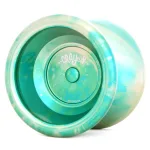
Only 35 Rainbowl 303s were made, each an exceptional masterpiece. The electroplating process has resulted in only a select few with an opulent blue hue in the hub, while the remaining ones have a resplendent light green tone. Like the raw batch, the Rainbowl 303s are polished to a gorgeous mirror finish.

The End Part II (Prelude) Batch II

The following was archived from RSO’s website:


The OG End emerged from the minds of yo-yo legends, the creative duo of Doc Pop and Phil Cox from Yes, Absolutely. With their visionary concepts, they entrusted the masterful craftsmanship of Nick Corea to bring their vision to life. The result was a yo-yo that exuded an elusive and captivating “it” factor.

Following the resounding success of the OG End, the much-anticipated End Part II took the yo-yo world by storm nearly two years ago. Boasting two runs named “Prelude” and “Finale,” these iterations presented avid yo-yo players with an opportunity to possess a refined version of the iconic classic, devoid of its previous limitations.

Despite a considerable number of units produced for both runs, the End Part II remains highly coveted, commanding prices that surpass its original retail value on the resale market. A significant proportion of players favor the Prelude over the Finale, despite the latter being closer in specifications to its predecessor.

The tale of this second batch of Preludes stretches back to 2021. Originally machined alongside the acid wash Preludes, these yo-yos were intended to be released in various colorways, including a splash iteration. However, the splash variation did not turn out as expected. The decision was made to strip their original anodization and re-anodize them in two distinct shades of solid orange. The re-anodized versions were breathtakingly beautiful, yet their assembly proved challenging due to a slightly looser bearing seat. Similarly, the Eetsit versions were plagued by anodization flaws, and also went through the tedious process of stripping and re-anodizing, with the bearing seats enduring the same fate. Consequently, my machinist and I concluded that the effort required to assemble and sell them was not worthwhile.

I struck a deal with my machinist to do another run, albeit at a considerable premium, which ended up as the Finale. This run afforded me the opportunity to further refine the End Part II’s CAD design, inching it closer to the origins of the beloved OG. The unassembled Prelude halves were destined for disposal.

Fast forward two years, an unexpected message from my machinist revealed that the long-forgotten Prelude halves still lay dormant in his possession.

Doc Pop and I swiftly convened on a Zoom call, resolutely accepting the challenge at hand.

The assembly process proved to be an arduous endeavor. While I procured a fresh batch of bearings to expedite the process, it necessitated a careful sequence of half swaps before attaining an A grade. It is important to note that the A grades, while they play exceptionally, do possess a slight tinge of vibration when spun vigorously. Remarkably, the vibration is so imperceptible that Doc Pop failed to notice it upon receiving the yo-yos (a detail I withheld from him beforehand). The red and white splash variations were so severely plagued by anodization flaws that only a handful made the cut.

Of the total quantity of yo-yos, only half were A grade and numbered. The B grades were marked with a “Yes, Absolutely” logo.

“Yes, Absolutely” engraving on the B grades.

The two orange hues are given the colorway names “It’s It” for the lighter variant and “Valencia” for the deeper shade.

The name “It’s It” draws inspiration from the It’s It ice cream treat, comprising a scoop of vanilla ice cream embraced between two oatmeal cookies and cloaked in dark chocolate. Notably, this colorway has a slightly darker orange tone compared to Finale.

“Valencia” finds its origins in both the citrus fruit of the same name and the very street where Doc Pop resided in the city of San Francisco. It is the darkest orange of all solid-colored Ends. A large portion of these were sent to Doc Pop.

The “Eetsit” colorway faithfully emulates the hues found on the OG Eetsit.

Inspired by the nostalgic charm of retro popcorn boxes, the “Popcorn” red and white splash colorway aligns with the movie theater theme depicted in the artwork. The handful of A grades were gifted to RSO collectors.

Finale (bottom left), Valencia (dark orange, on top) and It’s It (light orange, on the right) colorways of the End Part II (Prelude).
“It’s It” colorway, in a lighter shade of orange.
“Valencia” colorway, in a darker shade of orange.
“Eetsit” colorway, comprising brown and silver halves.
“Popcorn” colorway, consisting of a red base with silver / white splash.