Corvus

From Featherspin Throws:

“The dance of a yoyo is like the graceful descent of a falling feather, delicate yet purposeful. It moves with a rhythm that mimics the wingbeats of a bird—each throw, each catch, a movement of intention, a call to the sky. Yoyoing, much like a bird’s mating dance, is a communication of passion, a form of expression that speaks without words, yet speaks volumes.

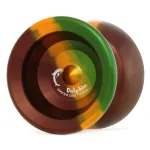
The Corvus: Named after the crow, a bird that symbolizes adaptability and intelligence, is built to dance with gravity, and to embrace the flow. The Corvus nods to the birds that soared before it, yet its design sings a new song. Think of it as nature’s hybrid vigor— blending lineage into something wholly

Featherspin Throws is a passion project born for the art of yoyoing. This is just a start, but if the way of the birds has taught us anything, it’s that every great journey begins with a single, powerful wingbeat.”

Initial colorways are:

  • “The Nest” – Brown Acid wash
  • “The Bird” – Lavender and Purple acid with grey Splatter
  • “The Egg” – green with black speckle
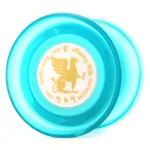
  • “The Shiny Trinket” – Clear Polished
  • “The Duller Trinket” – Clear Blasted

The End Part II (Prelude)

The following is archived from RSO’s website:


BEGINNING OF… THE END

The success of the Mecha-Bapezilla made me contemplate whether I should make a more competitively priced aluminium version so that a broader range of players would be able to try an RSO. Sonny and I had initially planned for a Bapezilla 3, a 54mm diameter version of the Bapezilla, which was almost 4g lighter than its predecessor. They were made in both C and D bearing versions. About a dozen of prototypes were made, and most were given away to RSO collectors.

C bearing prototypes of the Bapezilla 3 were anodized in the standard green and blue. The D bearing ones were anodized pink and black, a tribute to the Anti-Yo Fluchs.

One D bearing Bapezilla 3 prototype was put up for auction at the Scales Collective Fund Raiser for Social Justice (courtesy of Sonny) and raised a whopping 700 USD. Not too shabby for a 6061 aluminium yo-yo! Sonny loved the prototype, but I did not feel it was interesting enough for an RSO release. My main gripe was its floaty play-feel and its shorter nipple, both of which are uncharacteristic of the Bapezilla. Unfortunately, the Bapezilla 3 never made it into production, although I have had some requests for it to be made.

The Bapezilla 3 prototype (it was “Untitled” at that time) grossed the second highest amount at the Fundraiser for Social Justice auction, only second to the Scales Edition Mecha-Bapezilla.

I wanted to retain the aluminium Bapezilla play-feel and retain its looks without replicating the Bapezilla 1 for 1. This ultimately led me to the End – Part II project. The End was essentially a modified Anti-Yo Eetsit. It was the brainchild of a boutique company, Yes, Absolutely (consisting of the duo Doc Pop and Phil Cox) and meticulously machined by Nick Corea. The Eetsit had its fair share of problems, which were rectified with the End modifications, but these, in turn, created a new set of issues. More on these later. Only 22 pieces of the End were made, of which 17 were put up for sale.

I approached Doc Pop at the beginning of this year, and he agreed to collaborate on our first Zoom call. The guys from Anti-Yo, Sonny Patrick and Kiya Babzani, graciously gave us their blessings for the project.

THE END OF ALL PROBLEMS

To explain the End – Part II’s design considerations, I would have to start from the Eetsit. The Eetsit had a critical design flaw. There was no wall separating the bearing from the pads, causing the string to occasionally slip between the bearing and the yo-yo half (Fig.1, pink arrow). Modern yo-yos have a wall adjacent to the bearing (Fig. 1, green arrow), which avoids this problem.

Fig. 1 Eetsit bearing seat on the left, with the pink arrow showing the point where the string tends to slip in. Modern yo-yo designs have a wall adjacent to the bearing (green arrow), preventing string slippage. CADs are not drawn to scale.

Players resorted to two methods to mitigate the problem of string slippage on the Eetsit. The first method involved sanding down the bearing seat (Fig 2, yellow boxes), allowing the bearing to sit deeper within its seat (Fig 2, red and green boxes for comparison), but resulted in a reduction in the gap and width of the yo-yo. The second method involved using thicker response pads which was a disaster for tricks requiring multiple string layers.

Fig. 2 Before and after sanding down the Eetsit bearing seat. The bearing seats deeper within the seat (red VS green rectangles).

Modifying the Eetsit to the End involved machining a completely new bearing seat. The bearing was sunk in, the material around the bearing seat removed, and concentric rings called Schmoove grooves added. The resultant yo-yo had a 1mm reduction in its width (from 40mm to 39mm). Although removing material around the bearing seat helped to compensate for the decrease in gap brought about by sinking the bearing deeper, it also made the walls at the catch zone slightly higher. These modifications completely solved the problem of string slippage because a wall was created adjacent to the bearing seat, akin to the bearing seats of modern designs (Fig 3). However, this created another fatal problem – the walls at the yo-yo hub were too thin. As a result, the End was not durable and could literally break with enough force, particularly around the nipple (Fig. 3, blue arrow).

Fig. 3 Addition of Schmoove rings to the Eetsit halves. This made the walls of the hub paper thin (blue arrow) and easily breakable.

The End had a couple of other problems. The surface had a very aggressive blast which increased the risk of string cutting. Nonetheless, I must concede that the blotchy finish on the OG was beautiful and full of character. Some of the numbers engraved on the nipple were also not central. I presume this was due to the difficulty in aligning the yo-yo with the laser machine.

Broken OG End #2. Notice the paper thin walls.
Lopsided number engraving on Bryan Figueroa’s OG End #10.
The only B grade End – Part II (Prelude) for sale, #32 with a lopsided number engraving.
Although the OG End had a blotchy and rough finish, it was beautiful.

The approach I took for the End – Part II was to replicate precisely what Nick Corea did while making only bare minimum changes to the design, so as to avoid the problems of the OG yo-yo and retain its original play-feel. I thickened the walls of the hub slightly (it is still only about 0.8mm on the End- Part II, but a far more durable thickness). I wanted to keep the weight of the OG, so minimal weight was shaved off from the rest of the yo-yo body and added to the thickened hub. The unsightly machine lines at the rim were also cleaned up. The End – Part II is not identical to the original but plays extremely close to it.

A small batch of yo-yos was kept raw. These are polished to a mirror finish and look gorgeous. I hope to see some custom anodization done to these as a tribute to the bootleg nature of the OG run.

TRADEMARK SCHMOOVE GROOVES

Did you know the that Schmoove was spelt “Shmoove” without the “c” back in the day (see picture below)? Schmoove grooves are basically cuts in the catch zone adjacent to the bearing. These two recessed circles were a key component to The End design because they significantly reduced the surface area of string contact and friction with the high walls of the End. This was even more important with the narrower gap as a result of the modifications. The word SHMOOVE was engraved into the pad groove of the OG End.

Engraving on the End – Part II was more expensive than usual because I had explicitly requested that the machinist make two trips to the engraver. One to engrave the word SCHMOOVE, and one after assembly to engrave the external portion. This is to ensure that the external engravings on both halves will line up correctly.

An OG End prototype, still in the possession of Doc Pop today.
Notice the spelling of “SHMOOVE” instead of “SCHMOOVE” on the OG End.
An email dated 20 November 2007 from Nick Corea to Doc Pop, detailing the specifications of the Schmoove Grooves.

ART BY DOC POP, COLOR BY ATILA

The OG End was given its name simply because the Yes, Absolutely guys thought it was funny to release their very first yo-yo and call it “The End”. They had intended their next release to be called “The Middle” and a third yo-yo to be named “The Beginning”. The engraving on the OG End was inspired by the pixelated look of video games of that era.

For the End Part II, I wanted a cohesive theme between the art and engraving. The art concept I had come up with was a tongue in cheek reference to the modification process of the Eetsit, and the problems that came after it. As an owner of The End – Part II, looking at the box, it would feel like watching a movie of the Making of The End from start to finish. The cover art has an easter egg brilliantly included by Doc Pop – can you find it?

Can you find the names of Sonny, Kiya, Nick, Phil, Taka, Doc Pop and Elvin on the cover art?

I did not modify the shape of the rectangles of the engraving on the hub, but instead converted them subtly to film strips in keeping with the movie theme. The logo was inspired the album by The Doors of the same name. A bag of popcorn in the form of an enamel pin is included in the package for your enjoyment.

WHAT’S IN THE BOX

POPCORN ENAMEL PIN

A PAIR OF 19MM MAROON TYPE 40 LANDING PADS RESPONSE

CUSTOM STRING BY ARLEQUIN STRINGS

Sketch by Doc Pop.

The strings for the End – Part II were made by Arlequin (not his real name), an RSO collector from France. These are super fat strings composed of 33% polyester and 66% nylon. These are made to last longer than bulk polyester string and are equally suitable for both slacks and whips.

THE END – PART II (FINALE)

There is a massive demand for the End – Part II, and I have received countless messages on Instagram after it was announced.

People have asked – why did I make so few? I had initially ordered a much larger run of the End – Part II, but most of the run turned out to be B grade due to anodization. This was attributed to subpar 7068 aluminium bars. My machinist had graciously agreed to remake the rest of the batch. The B grade halves would be recycled.

As this is the first run of the End, it is called the Prelude.

I will be taking this opportunity to refine the End – Part II further. Expect subtle modifications to the Schmoove grooves and slightly rounder rims. I will still be engraving the numbers on the yo-yo for the second run, and they will also be made out of 7068 aluminium. The second run will be called the Finale.

If you are a big fan of the End, you have to own both runs even though their differences are subtle. If you miss out on a Prelude, don’t worry because there will be enough tickets to the Finale for everyone.

Gravity Lunar Edition

The following is archived from RSO’s website:


The Gravity has been my most popular original design to date. It was a risky endeavor with multiple components. A lot of trial and error was required to perfect the caps fit and machine a Side Effects removal tool that allowed players to remove the caps elegantly. The Gravity will be a stepping stone for other companies to do more independent Side Effects / modular releases. Shortly after the Gravity was released, I went back to the drawing board to see how else the weight of the yo-yo can be varied.

The Freehand served as the inspiration for Gravity. People used to add weight to their Freehands by adding weight rings, primarily made out of aluminium or delrin. These were suitable materials to use since they do not clash with the injection-moulded plastic body of the Freehand. Unfortunately, a removable aluminium ring was impossible for the Gravity as it would scratch the yo-yo, and my previous delrin experiment with the caps had failed.

I experimented with various ring designs made of polycarbonate and managed to CNC machine two new weight rings for the Gravity, weighing 0.9g and 1.9g. How my machinist makes the thinner weight ring baffles me. The heavier ring reminds me of the CLYW Bear Trap – to my knowledge, the aluminium rings are pressed fit in its the aluminium body.

0.9g weight ring.
A thicker 1.9g weight ring.

Despite having released two runs of cracked coated yo-yos, I still have no idea how this finish is done. The anodizer refuses to reveal the secret. In recent years, this finish was popularized by Turning Point, but the yo-yos often had a layer of anodization. For the Lunar Edition, the cracked pattern is layered on top of raw titanium. You can barely feel the cracked pattern with your fingers. The final product is a beauty to behold and is reminiscent of the surface of the moon.

Note: Lunar Edition will ship with all components included with the first run, plus two new sets of weight rings and a pair of stickers with new artwork. The CAD for the Gravity was not changed for the Lunar Edition – for first run Gravity owners, the new weight rings are available for sale separately and will fit your yo-yo.

Mecha-Bapezilla Side Effects Edition

The following is archived from RSO’s website:


THE YO-YO

The non-SE Mecha-Bapezilla was RSO’s first collaboration and one that helped give the company the initial push it needed (this is something I will always feel indebted to Sonny for). Over the years, different versions such as the Mecha-Viszilla, OG Edition and Godzilla Edition were released and were exceptionally popular. Collaborations with Sonny also allowed RSO to experiment with SEs in the YWETi SE Edition MK I and II, the first SE titanium yo-yos ever made. With the Gravity, I had designed what I thought was the perfect SE titanium yo-yo.

The Mecha-Bapezilla SE Edition halves were actually machined at about the same time as the YWETi SE Edition MK II in the fourth quarter of 2020. However, due to the limited availability of SEs and NSK DS bearings (I channelled what I had to YWETi and Gravity), the Mecha-Bapezilla SE Edition has taken a while to see the light of day.

THE PERFECT MIX

The Mecha-Bapezilla SE Edition comes equipped with premium parts including silver flat cap SEs from One Drop and platinum Double Straight C bearings from NSK.

This yo-yo is, in fact, the second SE version of the Bapezilla line. The first Bapezilla with SEs was the Bapezilla 2, a peculiar yo-yo. It was machined by One Drop and had a rough blasted finish called “Slip Matte Type III Hard Coat”, which tended to cut strings. Players resorted to smoothening its surface by rubbing it on denim. Initially, it was not as well-received as the OG Bapezilla. About 400 pieces were made and sold in batches at retailers and eventually on Massdrop. Despite being heavily discounted, they took a while to sell. Recently, the demand for the Bapezilla 2 has increased, with people scouring forums for it.

The Mecha-Bapezilla SE Edition has the revised more vertical nipple design like the YWETi MK II, staying true to the aesthetic of the OG Bapezilla. “If it ain’t broke, don’t fix it”, people say. I believe that a SE version of the OG design would have done better. Models like the Static Responsives Co. Parlay and Sudo, essentially SE versions of the OG Bapezilla design with minor tweaks, have been fan favourites. The Mecha-Bapezilla SE Edition is derived from the OG Bapezilla CAD and is the closest representation of what a SE Edition of the OG Bapezilla will play.

This is the last collaboration with Sonny. It has been an incredible ride with a meaningful friendship forged. RSO will be moving towards independent releases and original designs in the year 2022.

MECHA-BAPEZILLA SE EDITION
YWETi SIDE SE MK I

WHAT’S IN THE BOX

Certificate of authenticity IN THE FORM OF AN INSTRUCTION SHEET

ROCK THE BABY MECHA-BAPEZILLA ENAMEL PIN

A PAIR OF MAROON 19MM TYPE 40 RSO LANDING PADS

CUSTOM STRING BY ARLEQUIN STRINGS

Bowl XL Popsicle Edition

The following was archived from RSO’s website:


The Bowl XL: Popsicle Edition is a “lite” version of the Bowl XL that is 3g lighter than its older brother. It is slightly more well endowed and comes equipped with a 10mm axle instead of an 8mm one. This icy pole also does something which the regular Bowl XL can’t – it comes in five tasty flavors. Despite being almost identical in weight to the Atmos Projects Pomelo, the yo-yo retains the finger linkin’ good floaty play-feel of the Bowl series.

My machinist had made this small run of Bowl XL to compensate me for a large number of B grades from the OG run. 20 pieces were shipped to RSO supporters who had purchased a raw Mecha-Bapezilla Side Effects Edition as thank you gifts, while the rest of the stock was sold directly on the RSO store.