Before every wide-gap, silicone-padded, center-tracking throw came a simpler proposition: a player could make the yo-yo in hand do something its maker had not planned. Yo-yo modding is the long history of that proposition—part repair bench, part laboratory, part folk engineering.
The Player as Tuner
Players have always adjusted yo-yos. Fixed-axle throwers changed string, worked on axles, and wore response surfaces into the feel they wanted. But modern modding took shape when the late-twentieth-century yo-yo became a machine with parts that could be measured, swapped, spaced, and tuned. The goal was rarely novelty for its own sake. A mod answered a practical question: how can this yo-yo sleep longer, return more predictably, or leave more room for the string?
Tom Kuhn’s 1990 Silver Bullet 2 made that logic visible in a production yo-yo. Its ball-bearing axle and adjustable gap treated response as a variable rather than a permanent fact of the toy. That did not invent player modification, but it established a useful premise for the modern era: performance could be tuned.
The Gap Became a Frontier
As the 1990s boom pushed players toward longer combinations of string tricks, the narrow, responsive setups of earlier eras became a constraint. Bearing yo-yos could spin longer, but they still needed a balance between enough response to return and enough clearance to keep the string from catching. Spacers and shims gave players one way to move that balance; bearing swaps and response experiments gave them others.
One famous answer came in 1999, when Doctor Popular stacked two Henrys Viper bearings on one axle. The so-called beefcake mod opened usable space where a wider stock bearing did not exist, and the meeting point between the bearings also helped center the string. It is a useful example of modding at its most consequential: an improvised fix exposed a behavior later designed into commercial parts.
Response Was Rewritten at the Bench
Response systems offered another field for experimentation. Starburst, cork, rubber pads, O-rings, and later silicone all asked the same question in different materials: how much friction should meet the string at the moment of return? André Boulay’s account of the period places YoYoJam’s Matrixx and its O-ring response in 2002, while also describing the player pressure behind the change—durable response that was less grabby than a worn or heavily lubricated setup.
These experiments mattered because the emerging bind was not simply a new trick. It was a new agreement between player and yo-yo. A throw could run comparatively unresponsive through a complex sequence, then return when the player deliberately introduced string friction. Modders did not create that transition alone, but their home solutions tested the margins long before every solution arrived in retail packaging.
From Kitchen Tables to Lathes
Not every mod was an internal adjustment. Players reshaped bodies, removed material, dyed plastics, polished hubs, fitted alternative parts, and rebuilt damaged throws. The work could be subtle or theatrical, but it shared an ethic: a mass-produced object was a starting point, not a final instruction. By the middle of the 2000s, modding had enough of a public identity that World Yo-Yo Contest workshops included lathe instruction for turning and modifying yo-yos, plus timed mod battles.
That visibility also created a small craft economy. Skilled modders became known for particular operations and finishes, while online communities circulated photographs, warnings, and hard-won compatibility knowledge. A modification was often inseparable from the person who did it: the same model could become a different object through a different bench, tool set, or taste.
Knowledge Became Part of the Mod
Forums turned isolated experiments into shared practice. A player who had solved a bearing-seat problem, discovered a response material, or revived a damaged fixed axle could document the result for someone continents away. The record is uneven—old photo hosts disappear and names are sometimes harder to trace than the yo-yos—but it preserves the social side of modification: questions, failed attempts, warnings, and methods passed from hand to hand.
That exchange also set limits. A modification that weakens a yo-yo, damages a bearing seat, or uses tools beyond a player’s experience is not a rite of passage. The culture’s better tradition is careful experimentation: understand the part, accept the risk to the object, and learn from people who have already made the mistake.
Why Modding Still Matters
Modern production yo-yos arrive with wide gaps, standardized bearings, replaceable pads, precision machining, and choices that earlier players had to build for themselves. That has made some classic performance mods unnecessary. It has not made modding obsolete. Repair, restoration, fixed-axle tuning, custom finishes, 3D-printed experiments, and small-run maker culture all carry the same impulse forward.
The history of yo-yo modding is therefore not a straight march from crude hacks to perfected factory design. It is a conversation. Players identified possibilities, modified objects to test them, and sometimes gave manufacturers an idea worth absorbing. The best modded yo-yos retain the evidence of that conversation: performance shaped not only by a product brief, but by curiosity at the workbench.
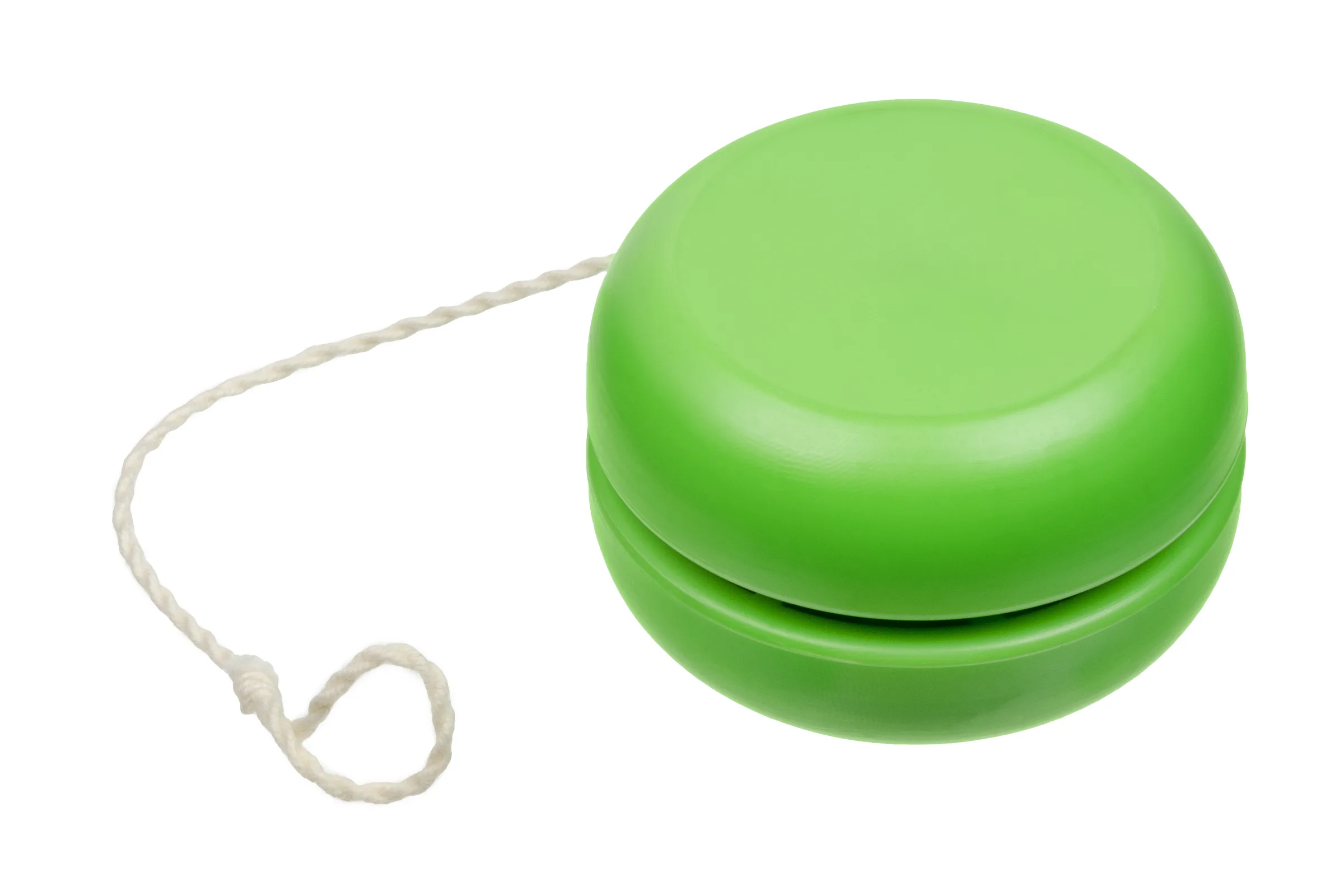
Featured image: Green plastic yo-yo by Evan-Amos, public domain, via Wikimedia Commons.